
Kentucky KYTC Permit Practice Test 9
Test 9 of 10. Pick an answer for each question to see if it is right and why; your score appears at the end. You need 32 correct answers to pass, the same ratio as the real Kentucky test.
- Questions40
- Correct to pass32
- Passing score80%
- Minimum age15 years
-
1. You are in a marked passing zone but a steady stream of oncoming traffic is coming toward you. What does the broken center line allow?
Show answer
Answer C: A pass only when the road is clear, so you have to stay behind
A passing zone marks where the sight distance is adequate, but it never gives permission to enter a lane that another vehicle is occupying.
-
2. On a rural road, the driver of a slow farm tractor ahead of you signals a left turn even though there is no road or driveway in sight. What should you do?
Show answer
Answer B: Stay behind the tractor, because it may be turning into a field entrance
Farm equipment often turns into fields through gaps you cannot see, and it may swing wide to do so. Passing a vehicle that is signaling a left turn is a common cause of crashes.
-
3. While you wait for the ambulance at a crash, what is the most useful help you can give?
Show answer
Answer C: Keep the person still and warm, and press down firmly on any heavy bleeding
Keeping an injured person still and warm and controlling bleeding are among the few things a bystander can safely do.
-
4. How many points does Kentucky assess for driving 16 to 25 miles per hour over the speed limit?
Show answer
Answer D: 6 points
Kentucky scores speeding in bands, and 16 to 25 miles per hour over the limit is assessed at six points.
-
5. You are the first to arrive at a crash on a rural road. What should you do first?
Show answer
Answer C: Park well clear of the scene, put on your hazard lights and call for help
Getting trained help on the way and keeping the scene visible does more good than anything an untrained bystander can do.
-
6. How is the Kentucky seat belt law enforced, and which vehicles does it cover?
Show answer
Answer D: Primary enforcement, vehicles manufactured after 1981, driver and all passengers
The Kentucky Driver Manual states that the driver and all passengers of a vehicle manufactured after 1981 must wear a properly adjusted and fastened seat belt, and that the seat belt law is primary in Kentucky so officers can stop a driver for that violation alone.
-
7. A sign with a blue background and a white legend and border tells road users about
Show answer
Answer A: services such as fuel, food, lodging, hospitals and rest areas
Blue is the background of the general service series, which points travelers toward the services available along or near the route.
-
8. What is the correct technique for backing a vehicle straight?
Show answer
Answer B: Check behind the vehicle before getting in, then turn and look through the rear window while backing slowly
Mirrors and cameras leave gaps close to the vehicle, so walk behind it first, then turn in your seat for a direct view and keep the speed low enough to stop instantly.
-
9. When no limit is posted, what is the Kentucky speed limit on state highways that are not interstates or parkways?
Show answer
Answer C: 55 miles per hour
The Kentucky Driver Manual lists 55 miles per hour as the speed limit on all state highways other than interstate highways and parkways.
-
10. Your low beams light about 250 feet of road, but at your speed you would need more than that to stop. What is that called?
Show answer
Answer D: Overdriving your headlights
When your stopping distance is longer than the stretch of road your headlights show, you cannot react to anything you finally see. Slow down until you can.
-
11. A yellow curve warning sign carries a yellow plaque showing a speed. What does that number mean?
Show answer
Answer D: The recommended maximum safe speed for the curve under ideal conditions
An advisory speed plaque on a yellow warning sign gives the recommended maximum speed for the hazard ahead when conditions are good.
-
12. On traffic control devices, the color green shows direction to a destination and also shows
Show answer
Answer C: that a movement is permitted
Green carries two assignments: guidance toward destinations, and the idea that the movement shown is allowed, as on a green arrow.
-
13. You and the driver facing you both have stop signs at a two-way stop. You are going straight and that driver is turning left. Who has the right of way?
Show answer
Answer B: You do, and the turning driver must wait
Between two opposing drivers who both stopped, the one going straight goes first and the left-turning driver yields.
-
14. Your lane is ending ahead in slow, heavy traffic and drivers in the next lane are already bumper to bumper. What is the recommended way to merge?
Show answer
Answer C: Take turns, one vehicle from each lane at the merge point
Alternating one for one at the merge point keeps both lanes moving and is the safest way to combine slow traffic.
-
15. How many points within a two year period may cause a Kentucky driver's privileges to be suspended?
Show answer
Answer B: 12 points for drivers 18 and older, or 7 points for drivers under 18
The Kentucky Driver Manual states that accumulating 12 points within a two year period, or 7 points for a driver under age eighteen, may lead to suspension after a hearing.
-
16. What may a Kentucky driver aged 18 or over do with a phone while the vehicle is in motion?
Show answer
Answer B: Use a global positioning device and select or enter a name or number to place a call
For drivers 18 and over Kentucky allows global positioning devices and allows reading, selecting or entering a telephone number or name in order to make a call.
-
17. At what distances must a Kentucky driver dim the high beams?
Show answer
Answer D: Within 500 feet of an oncoming vehicle and 300 feet of a vehicle being followed
Kentucky tells drivers to dim within 500 feet of an oncoming vehicle and within 300 feet of a vehicle they are following.
-
18. When no limit is posted, what is the Kentucky speed limit in a business or residential district?
Show answer
Answer C: 35 miles per hour
The Kentucky Driver Manual lists 35 miles per hour as the speed limit in a business or residential district, and 15 miles per hour in an off-street parking facility offered for public use.
-
19. Is it safe to check your phone while stopped at a red light?
Show answer
Answer B: No, you may miss the signal change and hazards around you
Attention does not return instantly when the light changes, and emergency vehicles, pedestrians or a rear-end threat can appear while you are stopped. Stay focused on the road.
-
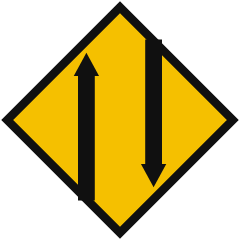
20. What is a driver being warned about here?
Show answer
Answer B: The pavement ahead carries vehicles traveling in the opposite direction
Beyond this point vehicles come the other way on the same pavement, which commonly happens where a one-way section or a separated stretch comes to an end.
-
21. Where is a strong crosswind most likely to hit you suddenly?
Show answer
Answer D: Coming out of a tunnel or a cut onto an open bridge
Gusts arrive the moment you leave shelter, which is why bridge approaches and the ends of cuts and tunnels catch drivers out.
-
22. A tractor-trailer is backing slowly across the roadway to enter a loading dock. What should you do?
Show answer
Answer C: Stop and wait until the truck has finished the maneuver
A backing truck driver has a very limited view and the trailer can swing unexpectedly. Trying to squeeze past in either direction risks being crushed.
-
23. When must a Kentucky driver file a written collision report with the Kentucky State Police?
Show answer
Answer A: Within ten days, when damage exceeds 500 dollars and no officer investigated
Kentucky requires a civilian written report within ten days when property damage exceeds 500 dollars and no law enforcement officer investigated the crash.
-
24. What testing does Kentucky require of an applicant who wants only a moped license and holds no other credential?
Show answer
Answer B: The vision screening and the written knowledge test, with no permit and no skills test
A first-time moped applicant takes the vision screening and the driver written test; Kentucky requires neither an instruction permit nor a skills test for this credential.
-
25. How much practice driving must a Kentucky teen record before becoming eligible for an intermediate license?
Show answer
Answer C: 60 hours, with 10 hours at night
The Kentucky Driver Manual requires a Practice Driving Log with a minimum of 60 hours of practice driving, 10 of which must be completed at night.
-
26. What is the purpose of a wide solid white line painted straight across your lane on the approach to an intersection?
Show answer
Answer C: It shows the point where a required stop must be made
A stop line indicates the point at which the stop required by a signal or a stop sign is to be made, ahead of the crosswalk and the intersection.
-
27. The passenger-side mirror on most vehicles is convex. What does this mean for the driver?
Show answer
Answer D: Vehicles in that mirror are closer than they appear
A convex mirror gives a wider view but shrinks what it shows, so a vehicle looks smaller and therefore farther away than it really is. Allow for this before changing lanes.
-
28. Where is a three-point turn most clearly a bad idea?
Show answer
Answer A: On a busy street near a curve, where approaching drivers cannot see you
The maneuver leaves you blocking the road for several seconds, so it needs light traffic and a long clear view; a blind curve gives neither.
-
29. By when must a Kentucky driver whose permit was issued before age 18 enroll in an approved driver training program?
Show answer
Answer C: Before the driver's eighteenth birthday
Kentucky requires drivers permitted under 18 to enroll in an approved driver training program before their eighteenth birthday and to finish it before full licensure.
-
30. Your right wheels have dropped onto a soft shoulder. Why should you not steer straight back onto the pavement?
Show answer
Answer A: The tires can catch the pavement edge and throw you across the road
A tire pressed against the edge of the pavement climbs it suddenly, and at speed that jolt can send the vehicle across the center line.
-
31. Your car is sinking after leaving the road into deep water and two children are in the back. In what order should you act?
Show answer
Answer D: Free yourself from the belt first, then release the children, the oldest one first
You cannot help anyone while you are still belted in, and the oldest child released first needs the least help getting out.
-
32. How many reckless driving convictions within twelve months can cost a Kentucky driver the license?
Show answer
Answer B: Three
Kentucky lists three reckless driving convictions within twelve months among the grounds for suspending or revoking a license.
-
33. How does heavy cargo on a roof rack change the way a vehicle handles?
Show answer
Answer D: It raises the center of gravity, so the vehicle tips more in turns and needs gentler steering
Weight carried high makes the vehicle lean more and roll over more easily, and extra weight lengthens stopping distance. Drive slower and steer smoothly with a loaded roof.
-
34. You have a green light at a school crossing, but the crossing guard steps out and holds up a stop sign toward you. What must you do?
Show answer
Answer A: Stop, because the crossing guard controls this crossing and outranks the signal
Directions from a crossing guard or a police officer take priority over signals and signs.
-
35. Rain is heavy enough that you have your windshield wipers running. What else should you switch on?
Show answer
Answer A: Your headlights, so you can see and others can see you
Rain heavy enough to need wipers also cuts how far away you can be seen, so the headlights belong on. Many states write this into law as a wipers on, lights on rule.
-
36. You are leaving a private driveway and entering a public street. What are you required to do?
Show answer
Answer B: Stop and yield to traffic on the street and to pedestrians on the sidewalk
A driver entering a roadway from a driveway, alley or private road must stop and yield to traffic on the roadway and to pedestrians on the sidewalk being crossed.
-
37. The red oil pressure warning light comes on while you are driving. What should you do?
Show answer
Answer C: Pull over safely as soon as possible and shut off the engine
Loss of oil pressure means the engine is no longer being lubricated and can be destroyed within minutes. Stop, shut down and check before restarting.
-
38. What color scheme does a standard stop sign use?
Show answer
Answer B: White legend and border on a red background
The stop sign carries a white legend and border on a red background, the color set aside for stop, yield and prohibition messages.
-
39. How much moving water is generally enough to float and carry away most passenger vehicles?
Show answer
Answer D: About one foot
About a foot of moving water will float most cars, and even less will stall an engine. That is why the rule is to turn around instead of judging the depth.
-
40. You have parked but your car sits across the line into the next space. What should you do?
Show answer
Answer B: Pull out and park again fully inside one space
A car over the line takes a space away from someone else and leaves too little room for the doors of the vehicles beside it.