
Kentucky KYTC Permit Practice Test 5
Test 5 of 10. Pick an answer for each question to see if it is right and why; your score appears at the end. You need 32 correct answers to pass, the same ratio as the real Kentucky test.
- Questions40
- Correct to pass32
- Passing score80%
- Minimum age15 years
-
1. What is the rule about leaving a child or a pet in a parked vehicle?
Show answer
Answer A: Never do it; the inside can turn deadly hot very quickly
The inside of a parked vehicle heats far faster than the air outside, and cracking a window does not prevent it, so a child or animal must never be left there.
-
2. What passenger limit applies to a Kentucky permit holder and to an intermediate licensee under 18?
Show answer
Answer D: One unrelated person under 20 years of age
The Kentucky Driver Manual limits both permit holders and intermediate licensees under 18 to one unrelated person under 20 years of age as a passenger.
-
3. What maximum design speed does Kentucky use in defining an electric low-speed scooter?
Show answer
Answer A: 20 miles per hour on a paved level surface
Kentucky defines an electric low-speed scooter as a device under 100 pounds designed to operate at a maximum of 20 miles per hour on a paved level surface.
-
4. The vehicle you have borrowed is larger and heavier than your own. How should you drive it?
Show answer
Answer B: Allow more room for stopping and for turns until you are used to it
Extra weight and length mean longer stopping distances and wider turns, so give yourself more room until you are used to it.
-
5. Your headlights suddenly go out while you are driving at night. What should you do?
Show answer
Answer A: Try the dimmer switch and the headlight switch, turn on the hazard lights and pull off the road
Switching between high and low beams or cycling the light switch sometimes restores the lights. If not, use the hazard and parking lights to get off the road safely.
-
6. What makes a left turn protected rather than permissive?
Show answer
Answer B: Oncoming traffic is held by a red signal while you have a green arrow
A protected turn is one where the conflicting movements are stopped by their own signal, which is what the green arrow indicates.
-
7. Your vehicle is stuck in deep snow and you run the engine for heat while waiting for help. What must you check?
Show answer
Answer C: That the exhaust pipe is clear of snow
Snow packed around the tailpipe pushes exhaust back into the cabin, and carbon monoxide can kill without warning. Clear the pipe and crack a window open.
-
8. In near freezing weather, which part of an otherwise clear road is most likely to still be icy?
Show answer
Answer D: A shaded dip under trees or beside a rock cut
Sun clears most of the road, but shaded hollows never warm up and can hold ice long after the rest of the pavement is dry.
-
9. You turn the wheel but the front of the vehicle keeps sliding straight ahead on a slippery road. What should you do?
Show answer
Answer C: Ease off the accelerator and reduce the steering angle until the front tires grip again
A front-wheel skid means the tires are asking for more grip than the surface can give. Less speed and less steering angle let them regain traction.
-
10. Why is wearing headphones over both ears a problem while driving?
Show answer
Answer D: You may not hear horns, sirens or other warning sounds
Hearing is part of your awareness of traffic. Covering both ears blocks emergency sirens, horns and the sound of an approaching vehicle you cannot yet see.
-
11. After Kentucky places a driver on probation instead of suspension, how long must pass before probation can be granted again?
Show answer
Answer C: Two years from the end of the previous probation period
A Kentucky driver placed on probation in lieu of suspension cannot be considered for probation again until two years have passed from the ending date of the earlier probation.
-
12. You signaled a lane change and the signal did not switch itself off afterwards. Why does that matter?
Show answer
Answer B: Other drivers may act on a turn you do not intend to make
A signal left on tells other drivers you are about to turn, and someone may pull out in front of you. Cancel it as soon as the maneuver is finished.
-
13. You drive away and the car feels sluggish while a warning light glows on the dash. What is a likely cause?
Show answer
Answer B: The parking brake was left partly applied
Driving with the parking brake partly on overheats the rear brakes and can ruin them, so release it fully and check that the warning light goes out.
-
14. How long is the suspension in Kentucky when a driver fails to appear for the hearing after a first accumulation of 12 points?
Show answer
Answer A: Six months
Missing the point hearing brings a six-month suspension for a first accumulation of twelve points, rising to a year and then two years for later accumulations.
-
15. How many points does Kentucky assess for failing to stop for a stopped school or church bus?
Show answer
Answer A: 6 points
Failing to stop for a school or church bus is one of the most heavily scored violations on Kentucky's schedule, at six points.
-
16. Is it acceptable to drive with your vehicle straddling the line between two lanes?
Show answer
Answer D: No, you must drive as nearly as practical entirely within a single lane
A vehicle astride the line takes up two lanes and leaves the drivers around it unable to predict where it will go.
-
17. On a Kentucky road with only one lane in the direction of travel, how much room must a driver leave when passing a bicycle or an electric low-speed scooter?
Show answer
Answer D: At least three feet
Kentucky requires at least three feet between the vehicle and a bicycle or electric low-speed scooter, held until the vehicle is safely past.
-
18. Besides school signing, which warning signs may also use a fluorescent yellow-green background?
Show answer
Answer C: Pedestrian and bicycle warning signs
Pedestrian crossing, bicycle and playground warning signs may use either the standard yellow or the fluorescent yellow-green background, which draws extra attention where people outside vehicles are present.
-
19. A sign at the signal reads LEFT TURN ON GREEN ARROW ONLY. The ball turns green but no arrow appears. What may you do?
Show answer
Answer C: Wait, because your turn is allowed only while the arrow is showing
The sign removes the permissive turn, so the left is legal only during the green arrow and you must wait behind the line until it appears.
-
20. How may a Kentucky student who lost driving privileges under No Pass/No Drive get them back?
Show answer
Answer C: By completing a semester in compliance, by turning 18, or by court order
Kentucky restores the privilege when the school reports compliance after a completed semester, when the student turns 18, or when a court orders reinstatement.
-
21. You leave your car so that its rear overhangs a marked crosswalk. What is wrong with that?
Show answer
Answer B: Pedestrians must step around it into the traffic lane
A crosswalk has to stay completely clear; anything sticking into it pushes people on foot out into the path of moving vehicles.
-
22. During the reversing part of a three-point turn, where should you be looking?
Show answer
Answer C: Over your shoulder through the rear window, glancing both ways
You look through the rear window in the direction the car is moving, checking both ways for traffic and people, because mirrors and cameras leave blind areas.
-
23. A tow truck with flashing amber lights is loading a car on the shoulder ahead. How should you treat it?
Show answer
Answer B: Give it the same room as an emergency vehicle
Tow operators, utility crews and highway workers face the same danger from passing traffic, so move over or slow down for their flashing amber lights too.
-
24. In a work zone a flagger signals you to stop, but the sign beside the road says the lane is open. What should you do?
Show answer
Answer C: Obey the flagger
A flagger controls the work zone in real time and the instruction outranks the signs and markings, which cannot reflect what is happening at that moment.
-
25. Where is the safest place for children under 13 to ride?
Show answer
Answer C: In the back seat
The back seat keeps children away from the force of a deploying front air bag and is farther from the most common impact area, which is why it is recommended through at least age 12.
-
26. As a general rule, how far should you travel along a center two-way left-turn lane before you turn?
Show answer
Answer C: Only a short distance, just enough to slow down and wait for a gap
The center lane is for making or preparing a left turn, so you enter it only shortly before the turn and never travel along it as a through lane; several states set a specific limit such as 200 or 300 feet.
-
27. Where is a U-turn generally the most reasonable choice?
Show answer
Answer B: At an intersection where it is permitted and you can see well both ways
A U-turn needs a legal place and a long clear view in both directions, which is why a permitted intersection with open sight lines is the usual choice.
-
28. The electric windows will not work as your vehicle sinks in water. What is the best option?
Show answer
Answer C: Break a side window with a hard, pointed object and climb out through it
Side windows are tempered glass and can be broken, while the laminated windshield cannot, and water pressure holds the doors shut.
-
29. You want to reverse direction but the street is too narrow for a U-turn. What is the alternative?
Show answer
Answer D: Make a three-point turn, or go around the block in heavy traffic
Where there is not enough width for a U-turn, the three-point turn does the job in stages, and on a busy street going around the block is safer still.
-
30. You are turning left at an intersection and an oncoming bicyclist is approaching in the bike lane. What must you do?
Show answer
Answer B: Yield and complete the turn only after the bicyclist has passed
A bicycle in the roadway has the same right of way as a vehicle, so a left-turning driver must yield to an oncoming rider just as to an oncoming car.
-
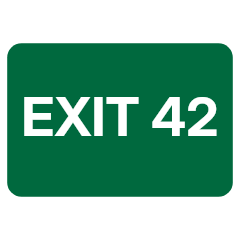
31. A driver in the left lane of a freeway realizes only when level with this sign that the ramp beside it is the one they need. What is the correct action?
Show answer
Answer A: Carry on to the next interchange and turn back from there
There is no safe way back to a ramp once it has been reached from the wrong lane, so the driver keeps going to the next interchange, where the ramps are built for that movement.
-
32. May a Kentucky motorist use hand signals instead of the vehicle's turn signals?
Show answer
Answer C: No, mechanical signals are required equipment and must be used
Kentucky requires mechanical turn signals as vehicle equipment and states plainly that hand signals cannot be used by a motorist.
-
33. When may a Kentucky permit holder under 18 or an intermediate licensee not drive without showing good cause?
Show answer
Answer C: Between midnight and 6:00 a.m.
The Kentucky Driver Manual states that permit holders under 18 and intermediate licensees may not drive between 12:00 a.m. and 6:00 a.m. unless they can demonstrate good cause such as an emergency, school or work.
-
34. You have stopped on an uphill grade close behind a large truck at a traffic signal. What is the risk?
Show answer
Answer B: The truck may roll back into you when it starts to move
Heavy vehicles can roll backward a short distance when the driver moves from the brake to the accelerator on a hill. Leave extra room when stopped behind a truck on a grade.
-
35. What happens when tires are driven underinflated for a long time?
Show answer
Answer D: They wear at the edges, they run hot and they are more likely to fail
An underinflated tire flexes too much, which wears the shoulders and builds up heat that can destroy the tire.
-
36. A student from another state attends a Kentucky university. What does Kentucky allow?
Show answer
Answer C: Driving on home-state registration and insurance while carrying a Kentucky student identification card
Kentucky lets students use their home-state registration and insurance so long as they keep a current student identification card from a Kentucky college, university or technical college.
-
37. What can happen to a Kentucky owner who fails to maintain insurance on a registered vehicle?
Show answer
Answer A: Registration revoked, plus a fine of 500 to 1,000 dollars, up to 90 days in jail, or both
The Kentucky Driver Manual states that failing to maintain insurance is a criminal offense, the vehicle registration is revoked, and the owner and driver face a fine of 500 to 1,000 dollars, up to 90 days in jail, or both.
-
38. What happens when alcohol is combined with another drug that also affects the nervous system?
Show answer
Answer B: Impairment is often far greater than either one alone would produce
Combined substances can multiply each other's effects, producing impairment well beyond what a driver would expect from either one taken separately.
-
39. Which practice matches current child passenger safety guidance?
Show answer
Answer D: Keep a child rear facing until the top height or weight limit of the seat is reached
A rear facing seat spreads crash forces across the child's whole back, so it should be used as long as the seat allows, and never in front of an active passenger air bag.
-
40. What penalty does Kentucky attach to unlawfully driving through or passing a funeral procession?
Show answer
Answer A: A 250 dollar fine or 90 days in jail
Kentucky backs its funeral procession rules with a fine of 250 dollars or 90 days in jail.