
Kentucky KYTC Permit Practice Test 2
- Questions40
- Correct to pass32
- Passing score80%
- Minimum age15 years
-
1. A delivery truck is parked in your lane and you must use the oncoming lane to get around it. Who has the right of way?
Show answer
Answer D: The oncoming traffic, because their lane is clear
The driver whose own lane is obstructed waits, because using the other lane is a favor from oncoming traffic, not a right.
-
2. You must cross a stretch of water lying across the road that you know is shallow. What is the right technique?
Show answer
Answer A: Slow down before you reach it and cross steadily in a low gear
Slow before the water, then keep a steady low speed so you do not throw water over the engine or lose steering. Test the brakes gently once you are through.
-
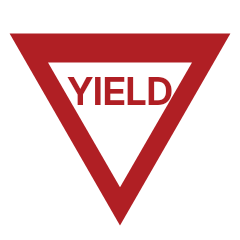
3. A driver passes this sign on an entrance ramp while merging onto a freeway. Who has priority?
Show answer
Answer B: The traffic already traveling on the freeway
The sign places the duty on the entering driver, who must adjust speed and fit into a gap without forcing through traffic to brake or swerve.
-
4. You have just had bad news and you feel very upset. What should you do?
Show answer
Answer B: Wait until you have calmed down, or else let somebody else drive
Strong emotion takes attention away from the road as surely as alcohol or fatigue, so it is a reason not to drive yet.
-
5. An orange background with a black legend on a sign indicates
Show answer
Answer B: a temporary traffic control or work zone situation
Orange is reserved for temporary traffic control signing, so an orange sign means conditions have been altered for work or another temporary operation.
-
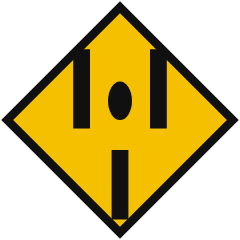
6. What should a driver do first after passing this sign?
Show answer
Answer A: Move into the right-hand lane and stay there
Traffic returns to two-way operation, so the driver keeps to the right of the centerline and stops treating the left side as available.
-
7. A turn restriction sign at the corner shows a range of times below the symbol. What does that mean?
Show answer
Answer A: The turn is banned only during the hours shown on the sign
Times posted under a regulatory symbol set the period during which the restriction applies; outside those hours the movement is permitted.
-
8. You are traveling beside a tractor-trailer and cannot see the truck driver's face in any of the truck's mirrors. What does that tell you?
Show answer
Answer A: The truck driver probably cannot see your vehicle
Large trucks have deep blind spots on all four sides, so if the driver's face is not visible in a mirror the driver has no view of you. Move ahead or drop back until you are out of that area.
-
9. You see a shield for a three-digit Interstate whose first digit is even. What does that tell you about the route?
Show answer
Answer C: It loops around a city and rejoins its parent route
A three-digit Interstate beginning with an even digit is a loop or beltway that connects back to the main route at both ends, while an odd first digit marks a spur.
-
10. What happens when tires are driven underinflated for a long time?
Show answer
Answer D: They wear at the edges, they run hot and they are more likely to fail
An underinflated tire flexes too much, which wears the shoulders and builds up heat that can destroy the tire.
-
11. While you wait for the ambulance at a crash, what is the most useful help you can give?
Show answer
Answer C: Keep the person still and warm, and press down firmly on any heavy bleeding
Keeping an injured person still and warm and controlling bleeding are among the few things a bystander can safely do.
-
12. A shared-use path crosses the road ahead at a marked crossing and people are already crossing on it. What should you do?
Show answer
Answer C: Yield and let them finish crossing the road
People already crossing at a marked crossing have the right of way, and a path crossing is a crossing of the roadway like any other.
-
13. Why is wearing headphones over both ears a problem while driving?
Show answer
Answer D: You may not hear horns, sirens or other warning sounds
Hearing is part of your awareness of traffic. Covering both ears blocks emergency sirens, horns and the sound of an approaching vehicle you cannot yet see.
-
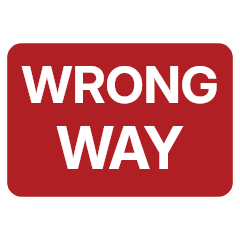
14. This sign comes into view ahead of a driver who has already started along a ramp. What should the driver do?
Show answer
Answer B: Pull clear where it is safe, then turn around and leave the ramp traveling properly
The driver is traveling against the legal flow, so the safest response is to stop clear of the lanes, turn the vehicle around and get off the ramp before meeting traffic head on.
-
15. How may an all-terrain vehicle lawfully cross a Kentucky two-lane public highway?
Show answer
Answer C: At as close to a ninety degree angle as is practical, traveling no more than two-tenths of a mile
Kentucky lets an all-terrain vehicle cross a two-lane public highway at as close to a right angle as is practical and safe, without traveling more than two-tenths of a mile on the highway.
-
16. Two vehicles meet on a steep, narrow mountain road with no room to pass. Which driver should back up?
Show answer
Answer C: The driver heading downhill, who has more control while reversing
On a narrow mountain road the vehicle facing downhill yields, because backing uphill gives better control than reversing down a grade.
-
17. You are approaching a yield sign and no other vehicle is anywhere in sight. What does the sign require?
Show answer
Answer A: Slow down and be ready to stop, but stop only if needed
A yield sign requires you to slow and give way, and to stop only when traffic or pedestrians make stopping necessary.
-
18. Before making a right turn at an intersection, what should you check besides oncoming traffic?
Show answer
Answer B: Your right blind spot and the crosswalk, for cyclists and pedestrians
Right turns often catch a cyclist or a pedestrian coming up on the right, so check the blind spot and the crosswalk before you turn.
-
19. A wide solid white line separates the through lanes from an exit lane. What does it tell drivers?
Show answer
Answer B: The choice of lane should already have been made
A channelizing line marks where the paths separate and crossing it is discouraged or prohibited, so the lane change has to happen upstream.
-
20. What testing does Kentucky require of an applicant who wants only a moped license and holds no other credential?
Show answer
Answer B: The vision screening and the written knowledge test, with no permit and no skills test
A first-time moped applicant takes the vision screening and the driver written test; Kentucky requires neither an instruction permit nor a skills test for this credential.
-
21. What passenger limit applies to a Kentucky permit holder and to an intermediate licensee under 18?
Show answer
Answer D: One unrelated person under 20 years of age
The Kentucky Driver Manual limits both permit holders and intermediate licensees under 18 to one unrelated person under 20 years of age as a passenger.
-
22. You are following closely behind a vehicle you intend to pass on a two-lane road. What should you do first?
Show answer
Answer D: Drop back to give yourself room to build speed before you pull out
From close behind you cannot see far enough ahead and you have no room to gather speed, so the pass takes longer and starts blind.
-
23. An orange sign reads RIGHT LANE CLOSED AHEAD. What is the correct response?
Show answer
Answer A: Move left in good time and keep a steady pace
The sign is placed well before the taper so that drivers can merge smoothly rather than braking hard where the lane actually closes.
-
24. A hands free phone conversation is which kind of distraction?
Show answer
Answer C: Cognitive, because your mind leaves the road
Hands free equipment removes the manual and visual parts of a call but not the mental load, and it is the mental load that makes a driver miss hazards.
-
25. A driver's blood alcohol concentration is below the legal limit, but the driver is visibly impaired. Can the driver be arrested?
Show answer
Answer C: Yes, driving while impaired by alcohol is an offense at any concentration
The per se figure, 0.08 percent in most states and 0.05 percent in Utah, is the level at which impairment is presumed. Impairment shown by driving behavior and field tests is enough on its own, because alcohol affects skills well before that number.
-
26. You are turning left across tracks that run along the center of the street. What should you do before crossing them?
Show answer
Answer B: Look along the tracks in both directions and cross only when clear
Rail vehicles running in the street can arrive from either direction and cannot stop quickly, so look along the tracks before you turn across them.
-
27. You arrive at an intersection where the traffic signal is completely dark because of a power failure. How should you proceed?
Show answer
Answer C: Treat the intersection as an all-way stop
When a signal shows no indication at all, drivers on every approach must stop and then take turns, exactly as at an all-way stop.
-
28. What is the safest way to deal with a vehicle sitting in your blind spot?
Show answer
Answer A: Slow a little or move ahead so that it is no longer beside you
You cannot control the other driver, but you can change your own speed so that the vehicle is no longer hidden beside you.
-
29. How many unexcused absences in one semester let a Kentucky school report a student for loss of driving privileges?
Show answer
Answer A: Nine
A Kentucky school may report a student to the Division of Driver Licensing as soon as the ninth unexcused absence occurs, or as soon as the student becomes academically deficient.
-
30. After submitting to the officer's chemical test, what right does a Kentucky driver have?
Show answer
Answer D: To have a blood test done by a qualified person of the driver's own choosing, at the driver's expense
Kentucky lets the driver arrange an independent blood test by a physician, nurse, phlebotomist or medical technician within a reasonable time of arrest, paid for by the driver.
-
31. A vehicle is sitting in your blind spot and you need to change into that lane. What should you do?
Show answer
Answer B: Adjust your speed to open a clear gap, then check again and move over
Changing your speed either drops the other vehicle behind you or lets it move ahead, which turns the blind spot back into open space.
-
32. Cones and drums mark a shifted lane through a work zone. What should you do?
Show answer
Answer A: Follow the path that they mark and stay inside it
Channelizing devices define the temporary travel path, and the space on the other side of them belongs to the workers.
-
33. You are at a red light where right turns on red are allowed, you cannot see clearly, and the driver behind sounds the horn. What should you do?
Show answer
Answer C: Stay stopped until you can see that the turn is safe
Turning right on red is permitted, never required, so you wait until you can see that the way is clear no matter what the driver behind does.
-
34. You have started to pass and you see the no-passing zone beginning ahead. What should you do?
Show answer
Answer D: Ease off, drop back and return to your own lane
A pass must be completed before the no-passing zone starts. If it will not fit, abandon it and slot back in behind.
-
35. Your loaded vehicle weighs more than the figure shown on a posted weight limit sign. What must you do?
Show answer
Answer D: Find another route, because crossing is not permitted
A posted weight limit is a legal maximum, not advice, so an overweight vehicle has to take a different route.
-
36. You reach an intersection showing a steady red light, and a stop line is painted across your lane. Where must you bring the vehicle to a complete stop?
Show answer
Answer C: Before the stop line
A steady red requires a complete stop before the marked stop line. Where there is no stop line you stop before the crosswalk, and where there is neither, before entering the intersection.
-
37. You are turning right where a paved trail crosses the road just past the corner. What should you look for?
Show answer
Answer B: Cyclists and walkers arriving from either direction on the trail
A shared use path carries two-way traffic on foot and on bicycles, so scan both directions along the trail before crossing it.
-
38. How should the inside rearview mirror be adjusted?
Show answer
Answer B: So you can see the entire rear window without moving your head
The inside mirror is for the view straight behind you. Framing the whole rear window from your normal seating position gives the widest useful view.
-
39. What should you do with the key and your belongings when you leave the vehicle in a public lot?
Show answer
Answer D: Take the key with you, lock up and put valuables out of sight
Most vehicle thefts are opportunistic: a key left behind or a bag in plain view is the invitation.
-
40. You need to reverse direction on a busy street. Which choice is usually safest?
Show answer
Answer D: Driving around the block and using the intersections instead
Going around the block uses normal turns at controlled intersections instead of stopping across live traffic lanes.