
Kentucky KYTC Permit Practice Test 1
Test 1 of 10. Pick an answer for each question to see if it is right and why; your score appears at the end. You need 32 correct answers to pass, the same ratio as the real Kentucky test.
- Questions40
- Correct to pass32
- Passing score80%
- Minimum age15 years
-
1. What does a tire with worn tread do on a wet road?
Show answer
Answer B: It loses grip and it hydroplanes at a lower speed than a good tire
Tread grooves carry water away from the contact patch, and a worn tire cannot do that, so it floats on the water sooner.
-
2. Once you have parallel parked, how close to the curb should your wheels be?
Show answer
Answer C: Within the distance your state allows, commonly 12 to 18 inches
Parking close to and parallel with the curb keeps the vehicle out of the traffic lane without damaging the tires; each state sets the exact maximum, usually 12 inches and 18 inches in some states.
-
3. How long is the license suspension for a first Kentucky DUI offense when the driver takes part in the ignition interlock program?
Show answer
Answer D: Four months
Kentucky shortens the first-offense suspension from six months to four when the driver enters the ignition interlock program.
-
4. You turn left onto a road that has a center two-way left-turn lane. In which lane should you be traveling once the turn is finished?
Show answer
Answer D: The first through lane to the right of the center turn lane
The shared center lane is only for turning movements, so even where a state lets you pause in it to merge you must end up in the first ordinary travel lane beside it.
-
5. Your road ends at a T-intersection with no signs or signals. Who has the right-of-way?
Show answer
Answer A: Traffic on the through road, and you must yield before entering
A driver on a road that ends at a T-intersection must yield to traffic on the through road that continues past the junction.
-
6. What alcohol concentrations put a Kentucky driver in violation of the driving under the influence law?
Show answer
Answer B: 0.08 for drivers 21 and over, and 0.02 for drivers under 21
The Kentucky Driver Manual states that a person violates the law by operating with an alcohol concentration of 0.08 or above, and that a person under twenty-one is in violation at 0.02 or more.
-
7. Why is the road often most slippery during the first few minutes of rain after a long dry spell?
Show answer
Answer C: Oil and dust on the surface mix with the water into a slick film
Oil drippings and road dust build up on dry pavement, and the first light rain lifts them into a slippery film before heavier rain washes it away.
-
8. Why are motorcycles so often missed by other drivers?
Show answer
Answer C: Their narrow shape is easily hidden in traffic
A motorcycle presents a narrow outline that disappears behind pillars, mirrors and other vehicles, and it is harder to judge its speed and distance.
-
9. How do extra passengers affect a driver, especially a new one?
Show answer
Answer A: They increase the chance of distraction and of crashes
Conversation, laughter and horseplay pull a driver's attention away from the road. Crash risk for young drivers rises with each additional passenger.
-
10. You are driving on a two-lane road approaching the crest of a hill. Where should you position your vehicle?
Show answer
Answer D: Toward the right side of your lane, in case an oncoming vehicle is over the center line
You cannot see what is beyond a crest, and oncoming drivers sometimes drift across the center. Keeping right and slowing gives you a margin.
-
11. Your vehicle leaves the road and enters deep water. What gives you the best chance of escape?
Show answer
Answer B: Release your seat belt and get out through a window as quickly as possible
Water pressure holds the doors shut, so a window is the reliable exit and the first seconds after entry are the best time to use it.
-
12. Which engine and speed limits does Kentucky use in its legal definition of a moped?
Show answer
Answer A: No more than two brake horsepower, a cylinder capacity not exceeding 50 cubic centimeters, and a top speed of 30 miles per hour
The Kentucky Driver Manual defines a moped by these three limits together; a machine that exceeds any of them is licensed as a motorcycle.
-
13. Visibility drops suddenly and you decide to leave the highway. What is the safest way to do it?
Show answer
Answer A: Take the next exit or a wide pull off, well clear of the traffic lanes
Get right off the traveled way, and off the shoulder too if you can, because vehicles in poor visibility often drift onto the shoulder.
-
14. Where is this sign normally installed?
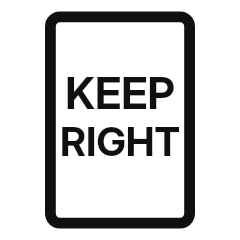
Show answer
Answer A: At an island or other obstruction in the roadway, to show which side traffic must take
It is placed at a divider, island or fixed obstruction so that drivers approaching it know without hesitating which side to pass on.
-
15. You are on an entrance ramp merging onto a freeway. Who has to give way?
Show answer
Answer B: You must yield and fit into a gap in the traffic already on the freeway
Traffic entering a highway must yield to traffic already on it. Use the acceleration lane to match speed and merge into a gap.
-
16. You are behind a slow vehicle on a two-lane road and a marked passing lane begins a mile ahead. What is the sensible choice?
Show answer
Answer D: Wait for the passing lane rather than using the opposing lane
A passing lane lets you overtake without ever entering the lane used by oncoming traffic, which is far safer than a pass a minute earlier.
-
17. A sign at the start of an exit ramp shows a speed much lower than the highway limit. What does it apply to?
Show answer
Answer C: The curve of the ramp itself, once you have left the highway
The ramp speed is set by the sharpness of the ramp curve, so you slow to it inside the deceleration lane rather than out on the highway.
-
18. How long do points and the underlying conviction remain on a Kentucky driving record?
Show answer
Answer A: Points expire in two years and the conviction stays for five years
The Kentucky Driver Manual states that points expire two years from the date of conviction, while the conviction entry remains part of the driving record for five years.
-
19. Blue pavement markings are used together with white markings at
Show answer
Answer D: parking spaces reserved for people with disabilities
Blue supplements the white markings of accessible parking spaces, which is the only assignment blue has on the pavement.
-
20. The signal ahead turns yellow while you are approaching it. What does the yellow light mean?
Show answer
Answer C: The red is coming; stop if you can do so safely
A steady yellow warns that the red is next. Stop if you can do so safely; enter the intersection only when stopping would be dangerous.
-
21. You have to leave a trailer parked on a slope. What extra step protects it?
Show answer
Answer D: Chock the trailer wheels as well as setting the brake
Chocks physically block the wheels, which is the only thing that still holds if a brake or a coupling lets go.
-
22. How long must a Kentucky permit holder aged 15 to 20 hold the permit before taking the road test?
Show answer
Answer C: A minimum of 180 days
The Kentucky Driver Manual requires permit holders ages 15 through 20 to hold the driving permit for a minimum of 180 days before becoming eligible for the road test.
-
23. A sign with a black legend on a fluorescent pink background is used for
Show answer
Answer A: traffic incident management
Fluorescent pink is set aside for signing that manages traffic around a crash, a spill or another unplanned incident, so it stands apart from routine work zone orange.
-
24. Which of these does NOT affect how fast alcohol reaches the bloodstream?
Show answer
Answer A: How confident the drinker feels
Food, the strength of the drinks and the speed of drinking all change how fast alcohol is absorbed, but a drinker's confidence changes nothing at all.
-
25. At a railroad crossing with no gates and no flashing lights, the crossbuck is normally combined with which sign?
Show answer
Answer C: A yield sign, or a stop sign where an engineering study calls for one
At a passive crossing the crossbuck forms an assembly with a yield sign, or with a stop sign when an engineering study or engineering judgment supports it, so the driver knows who must give way to the train.
-
26. A person moving to Kentucky holds an out-of-state license that has been expired for more than one year. What does Kentucky require?
Show answer
Answer B: A certified driver history record or clearance letter from the former state, plus the written and vision tests
When the out-of-state license has been expired more than a year, Kentucky asks for a full certified driving record or clearance letter and puts the applicant back through the written and eye exams.
-
27. What does Kentucky do when a driver is convicted of exceeding the speed limit by 26 miles per hour or more?
Show answer
Answer A: A hearing is held and the driving privilege may be suspended
At the top speeding band Kentucky stops assigning points and calls the driver to a hearing, after which the privilege may be suspended.
-
28. A pedestrian near the curb is staring at a phone and not looking at traffic. What should you do?
Show answer
Answer A: Slow down and be ready to stop, because the pedestrian may step out without looking
Distracted pedestrians step into the street without checking. Assume they have not seen you and give yourself time and space to stop.
-
29. What happens to a Kentucky registration when the insurer stops reporting coverage and no proof is supplied?
Show answer
Answer C: The registration is canceled after a 90-day monitoring period
Kentucky's insurance verification system monitors the vehicle for 90 days after reported coverage lapses, and cancels the registration if proof is not supplied.
-
30. When did Kentucky enact its Move Over law?
Show answer
Answer D: 2003
Kentucky passed its Move Over law in 2003, requiring drivers to move over for emergency and public safety vehicles displaying flashing lights.
-
31. What minimum score must a Kentucky applicant achieve to pass the written knowledge test?
Show answer
Answer C: 80 percent
The Kentucky Driver Manual states that applicants must make a minimum score of 80 percent to pass the written test, which is administered by the Kentucky State Police.
-
32. You notice that the driver ahead of you is holding a phone to the ear. What should you do?
Show answer
Answer C: Assume slower reactions and leave extra space, or else hold back
A driver on the phone reacts late and misses things, so the safe response is distance rather than a lesson.
-
33. Travelling at about 55 mph on dry pavement, roughly how much room does an average car need to perceive, react and stop?
Show answer
Answer D: About 300 feet, close to the length of a football field
Reaction distance plus braking distance at 55 mph comes to roughly 300 feet on good dry pavement, and considerably more on a wet or loose surface.
-
34. Why should you avoid parking over tall dry grass or a pile of dead leaves?
Show answer
Answer B: Because the hot exhaust can set the dry material on fire
The exhaust system stays hot for a long time after a drive and can ignite dry vegetation underneath the vehicle.
-
35. How does alcohol typically affect a driver's vision?
Show answer
Answer D: It blurs vision, weakens night vision and narrows attention to the sides
Alcohol slows the eye muscles and the brain's processing of what is seen, degrading focus, night vision, depth perception and awareness of movement at the edges of the field of view.
-
36. How many points does Kentucky assess for failing to yield to an emergency vehicle?
Show answer
Answer C: 4 points
Kentucky's point schedule assesses four points for failure to yield to an emergency vehicle.
-
37. How many points does Kentucky assess for improper passing?
Show answer
Answer B: 5 points
Improper passing carries five points on a Kentucky driving record.
-
38. Where is passing prohibited even when no line is visible?
Show answer
Answer D: On a curve or near the crest of a hill, at intersections and at railroad crossings
Passing is prohibited wherever your view of oncoming traffic is blocked or where vehicles may cross your path, which includes hills, curves, intersections and rail crossings.
-
39. What counts as a complete stop at a stop sign?
Show answer
Answer C: The wheels stop turning before the stop line
A legal stop means the vehicle is no longer moving, made at the stop line or before entering the crosswalk or intersection.
-
40. A driver is following you far too closely and you have a turn coming up. How should you slow down for it?
Show answer
Answer B: Signal early and slow gradually well before the turn
Early signals and gentle braking give a tailgater the time and distance they have failed to leave for themselves.