
Kentucky KYTC Permit Practice Test 7
Test 7 of 10. Pick an answer for each question to see if it is right and why; your score appears at the end. You need 32 correct answers to pass, the same ratio as the real Kentucky test.
- Questions40
- Correct to pass32
- Passing score80%
- Minimum age15 years
-
1. A center lane is bordered by a solid yellow line on the outside and a broken yellow line on the inside, with turn arrows painted inside it. What is that lane for?
Show answer
Answer C: Left turns made by traffic traveling in either direction
That marking pattern identifies a two-way left-turn lane, which drivers approaching from both directions may use to prepare for a left turn.
-
2. Which common non-prescription medicine is most likely to make a driver drowsy?
Show answer
Answer C: A cold or allergy remedy containing an antihistamine
Antihistamines in cold and allergy remedies are a leading cause of drowsiness behind the wheel, which is why the label carries a warning.
-
3. You see brake lights several vehicles ahead of you in your lane. What is the best first step?
Show answer
Answer C: Ease off the gas and cover the brake pedal
Reacting to the trouble several vehicles ahead, rather than waiting for the car in front, cuts your reaction time and warns the driver behind you.
-
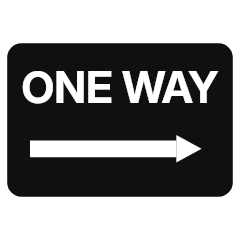
4. A driver disregards this sign and turns so as to travel against the direction it establishes. What is the immediate danger?
Show answer
Answer D: The driver will face traffic head on, because every lane comes the other way
Turning against the established direction puts the vehicle nose to nose with all the traffic on that street, which is why the mistake has to be corrected at once.
-
5. A flagger in a work zone turns a paddle so that the red octagonal face reading STOP is toward you. What must you do?
Show answer
Answer A: Stop completely and wait for the flagger to signal you forward
The STOP face of a flagger paddle requires a complete stop, and you may move again only when the flagger directs you to.
-
6. Enhanced reference location markers differ from ordinary mileposts in that they
Show answer
Answer B: carry the route number and a mileage figure to the tenth of a mile
An enhanced reference location marker adds the route designation and carries the mileage to a tenth, so the point named is far more precise than a plain milepost.
-
7. You are about to pass a bicyclist on a narrow two-lane road. What is the correct way to do it?
Show answer
Answer A: Wait for a clear gap and move well left, giving the rider wide space
Pass a cyclist as you would a car: wait for clear road, change lane position to leave generous clearance, and return only when the rider is well behind you.
-
8. The vehicle in front of you has stopped and is waiting to turn left, and there is a paved shoulder to the right. May you use it to get by?
Show answer
Answer D: No, in most states a pass may not be made by leaving the paved travel lanes
Passing on the right is normally lawful only inside the marked travel lanes, and most states prohibit driving onto the shoulder to get around a turning vehicle; the few states that allow it attach strict conditions.
-
9. A crash happens directly in front of you and vehicles are blocking both lanes. What should you do?
Show answer
Answer B: Stop at a safe distance, put on the hazards and warn the traffic behind
The greatest danger after a crash is a second collision, so stop short of it and make sure the traffic behind you can see the problem.
-
10. You are about to descend a long steep grade. How should you control your speed?
Show answer
Answer D: Select a lower gear before starting down and use the brakes in firm, brief applications
Engine braking in a lower gear carries most of the load down the grade, while continuous brake pressure overheats the brakes and reduces their effectiveness.
-
11. Which drivers are not eligible to attend Kentucky State Traffic School?
Show answer
Answer C: Non-licensed drivers and drivers licensed in another state
Kentucky State Traffic School is open only to Kentucky licensees; non-licensed and out-of-state drivers cannot attend.
-
12. You turn from asphalt onto a loose gravel road. What should you do about your speed?
Show answer
Answer D: Lower it, since grip is reduced and stopping takes longer
Loose gravel gives far less grip than pavement, so speed must come down for both steering and stopping.
-
13. What speed limit does Kentucky set for an off-street parking facility offered for public use?
Show answer
Answer B: 15 miles per hour
Kentucky fixes the speed limit in an off-street parking facility offered for public use at fifteen miles per hour, whether the lot is publicly or privately owned.
-
14. A funeral procession with headlights on is crossing an intersection when your light turns green. What should you do?
Show answer
Answer A: Wait and let the whole procession go through
Most states let a funeral procession stay together once the lead vehicle has lawfully entered an intersection, and in every state you must yield to vehicles already in the intersection, so wait until the line has passed.
-
15. What fines does Kentucky impose for violating its personal communication device law?
Show answer
Answer B: 25 dollars for a first offense and 50 dollars for each later offense, plus court costs
Kentucky fines a first device violation 25 dollars and each subsequent violation 50 dollars, with court costs added.
-
16. What does Kentucky's move over guidance require on a four-lane highway when approaching an emergency vehicle stopped on the shoulder?
Show answer
Answer D: Approach slowly and move into the left lane if it is safe to do so
The Kentucky Driver Manual states that drivers must exercise due caution, approach slowly and move into the left lane on four-lane highways when it is safe, and on two-lane highways approach slowly and pass with caution.
-
17. For a Kentucky driver aged 21 or over, when does the license expire and how early may it be renewed?
Show answer
Answer B: It expires 31 days after the driver's birthday and may be renewed up to six months early
An adult Kentucky license runs out a month after the birthday, and the Transportation Cabinet opens renewal half a year before that date.
-
18. How long must a Kentucky applicant wait before attempting the road skills test again after failing it?
Show answer
Answer A: At least one week
Kentucky requires a wait of at least one week from the date of a road test failure, and encourages the applicant to practice in that time.
-
19. A Kentucky driver under 18 wants to type a destination into a navigation app. When is that allowed?
Show answer
Answer B: Only while the vehicle is stopped
Kentucky lets a driver under 18 use a global positioning system, but manually entering information into it must be done while the vehicle is stopped.
-
20. Two left-turn lanes are available and you must turn right again a short distance after the turn. Which of the two should you use?
Show answer
Answer D: The right one, so you finish nearer the right side of the new street
Each turn lane feeds the matching lane of the new street, so choosing the right-hand of the two left-turn lanes leaves you closer to the side you will need.
-
21. Why should you avoid swinging wide to the left before making a right turn in a car?
Show answer
Answer A: Another driver may think you are turning left and try to pass on your right
Swinging left first misleads other road users about your intention and invites someone to move up on your right, exactly where you are about to go.
-
22. An emergency vehicle is stopped on the shoulder ahead with its lights flashing. What does the move over principle require?
Show answer
Answer D: Change lanes away from it, or slow down if you cannot
Move over laws ask you to give responders an empty lane, and where traffic or a two-lane road makes that impossible, you slow down instead.
-
23. The motorcyclist ahead of you keeps moving from one side of the lane to the other. What should you understand?
Show answer
Answer B: The rider is avoiding surface hazards and staying where drivers can see the bike
Riders shift their lane position to avoid debris, grease strips and potholes and to be seen. That movement is normal and never an invitation to share the lane.
-
24. Which shape is used for the school advance warning sign and the school crossing sign?
Show answer
Answer B: An upward-pointing pentagon
The five-sided pentagon with its point up identifies school signing, so the outline alone tells a driver that children may be present.
-
25. When no limit is posted, what is the speed limit on Kentucky interstate highways and parkways?
Show answer
Answer C: 65 miles per hour
The Kentucky Driver Manual lists 65 miles per hour as the speed limit on interstate highways and parkways, although the secretary of transportation may raise specific highways to 70.
-
26. What is the usual result of driving well above the flow of traffic on a typical trip?
Show answer
Answer B: Very little time saved, with much greater risk
Signals, traffic and short distances swallow the theoretical gain, while crash risk and crash severity both climb sharply with speed.
-
27. You are turning right from a one-way street onto a two-way street. Where should the turn end?
Show answer
Answer A: In the lane nearest the right curb of the street you are entering
A right turn starts and finishes as close to the right as practical, so you leave the one-way street from the right lane and arrive in the lane nearest the right curb.
-
28. What is worth carrying in the vehicle during a winter trip?
Show answer
Answer A: A blanket, a flashlight, a scraper and a small shovel
A winter kit keeps you warm and visible if you are stopped for hours, and lets you clear glass and dig the wheels out. Hot water can crack cold glass.
-
29. A truck passes you in heavy rain and its spray blanks out your windshield. What should you do?
Show answer
Answer B: Hold the wheel steady, ease off slightly and let the wipers clear it
The blackout lasts a second or two. Keeping your line and easing off is far safer than braking hard or steering blind toward the shoulder.
-
30. Is it a good idea to shift into neutral and coast down a long hill to save fuel?
Show answer
Answer B: No, you lose engine braking and some control of the vehicle
In neutral the engine cannot help slow the vehicle, so the brakes do all the work and can overheat. Stay in gear so the drivetrain helps hold your speed.
-
31. How recent must a Kentucky Graduated Driver License Skills Test Eligibility Letter be on the day of the road test?
Show answer
Answer A: Within seven days of its print date
The eligibility letter is meant to show the applicant qualifies on the day of the appointment, so Kentucky accepts it only within seven days of printing.
-
32. Why are sign shapes and colors standardized across the whole country?
Show answer
Answer D: So a driver knows the kind of message before reading it
Uniform shapes and colors let a driver classify a sign as regulatory, warning or guide from a distance, before the legend can be read.
-
33. After submitting to the officer's chemical test, what right does a Kentucky driver have?
Show answer
Answer D: To have a blood test done by a qualified person of the driver's own choosing, at the driver's expense
Kentucky lets the driver arrange an independent blood test by a physician, nurse, phlebotomist or medical technician within a reasonable time of arrest, paid for by the driver.
-
34. What is the safest way to handle an unrestrained pet or a child who needs attention while you are driving?
Show answer
Answer D: Secure pets before the trip and pull over safely before attending to a child
A loose animal or an urgent situation in the back seat can capture a driver's attention completely, so restrain pets beforehand and stop in a safe place when someone needs help.
-
35. What does a posted speed limit sign represent?
Show answer
Answer B: The maximum speed permitted under ideal conditions
A speed limit is an upper limit that assumes good weather, good visibility and light traffic, so the safe speed is often lower than the posted figure.
-
36. You must stop for a train at a highway-rail crossing. Where should you stop?
Show answer
Answer B: Behind the stop line, gate or signal and well clear of the nearest rail
Stop behind the stop line, gate or flashing-light signal and well clear of the nearest rail, because a train overhangs its track by several feet on each side.
-
37. Why is backing up on a freeway or on its shoulder prohibited?
Show answer
Answer A: Traffic arrives far too fast to expect a vehicle moving the wrong way
Freeway traffic closes on a stopped or reversing vehicle at highway speed and has almost no time to react to something moving against the flow.
-
38. What written proof of liability coverage does Kentucky accept in a vehicle?
Show answer
Answer B: A paper insurance card or the same card shown on a portable electronic device
Kentucky requires written proof of minimum liability coverage in the vehicle, and the insurance card may be on paper or downloaded to a portable electronic device.
-
39. How many points does Kentucky add to a driving record for texting while driving?
Show answer
Answer B: 3 points
Kentucky's point schedule lists texting while driving at three points, alongside its other moving hazardous violations.
-
40. Why is being predictable an important part of driving safely?
Show answer
Answer A: Because other road users are able to plan around what you are doing
Other drivers make their decisions from what they expect you to do, so surprises are what produce collisions.