
Kentucky KYTC Motorcycle Practice Test 5
Test 5 of 6. Pick an answer for each question to see if it is right and why; your score appears at the end. You need 24 correct answers to pass, the same ratio as the real Kentucky test.
- Questions30
- Correct to pass24
- Passing score80%
- Minimum ageSee note
-
1. A flashing red lamp is mounted above a stop sign at a rural intersection. What does it add?
Show answer
Answer C: Emphasis, while the required stop stays the same
A stop beacon makes an easily missed stop sign more visible, but it neither adds to nor takes away from the obligation the sign already imposes.
-
2. A large truck passes and hits you with a blast of wind. Which lane position leaves you the most room for error?
Show answer
Answer A: The center portion of the lane
A rider in the center portion of the lane has space on both sides to absorb the push of a wind blast without being shoved out of the lane.
-
3. A police officer in the intersection raises a hand toward you although your signal is green. What should you do?
Show answer
Answer B: Stop and wait for the officer to wave you on
An officer directing traffic overrides signals and signs, and drivers must follow the officer even when the light says otherwise.
-
4. An arrow panel at a work zone displays a flashing arrow pointing to the left. What does it require?
Show answer
Answer C: Move out of the closed lane into the lane on the left
A flashing or sequential arrow on an arrow panel directs traffic out of a closed lane and into the lane the arrow points to.
-
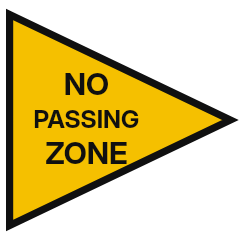
5. A driver is thinking about overtaking a slower vehicle and sees this sign a short distance ahead. What does it mean for that pass?
Show answer
Answer B: The pass must be finished before the restricted section begins
The sign marks the start of a section where passing is prohibited, so a driver may not be on the left side of the road beyond it; any pass has to be completed before that point or not started at all.
-
6. At a freeway exit, the paved triangle between the ramp and the through lanes is filled with diagonal white lines. What do they mean?
Show answer
Answer A: Stay out of that area, because it is not meant to be driven on
Chevron and diagonal markings fill paved areas that traffic is not intended to use, so drivers should keep out of them.
-
7. During which period does Kentucky require headlights to be illuminated?
Show answer
Answer D: From one-half hour after sunset to one-half hour before sunrise
Kentucky requires headlights from one-half hour after sunset until one-half hour before sunrise.
-
8. What does the Lights and Electrics step of T-CLOCS include?
Show answer
Answer A: The battery, the headlight, the brake light and the wiring
This step covers the battery and its terminals, the headlight, tail and brake lights, the turn signals, the switches, the mirrors and the wiring.
-
9. A sign with a blue background and a white legend and border tells road users about
Show answer
Answer A: services such as fuel, food, lodging, hospitals and rest areas
Blue is the background of the general service series, which points travelers toward the services available along or near the route.
-
10. Which drivers does Kentucky's ban on texting while driving cover?
Show answer
Answer A: Drivers of all ages, whenever the vehicle is in motion
House Bill 415 bans texting for Kentucky drivers of every age while the vehicle is in motion; it is not one of the graduated licensing restrictions.
-
11. When is passing another vehicle on the right generally permitted?
Show answer
Answer C: When the road has two or more lanes in your direction, or the vehicle ahead is turning left and there is room without leaving the pavement
Passing on the right is limited to situations where a lawful lane exists for it or the vehicle ahead is turning left, and it may never be done by driving onto the shoulder.
-
12. Why is parking next to a fire hydrant or in a marked fire lane prohibited?
Show answer
Answer D: It would delay firefighters who need immediate access to the hydrant or the building
Fire hydrants and fire lanes must remain clear at all times so emergency crews can connect hoses and reach a building without delay.
-
13. You are backing out of a space in a parking lot. Who has the right of way?
Show answer
Answer D: Traffic already moving in the lane, and pedestrians walking behind you
A driver backing out must yield to vehicles and pedestrians already using the lane, because backing is the movement with the poorest view.
-
14. How many points does Kentucky assess for a reckless driving conviction?
Show answer
Answer D: 4 points
Kentucky's point schedule places reckless driving at four points, above careless driving and below improper passing.
-
15. A yellow pennant-shaped sign is posted on the left side of a two-lane road facing you. What is it telling you?
Show answer
Answer B: You are entering a no-passing zone and may not start a pass
The pennant is placed on the left so that it faces the driver who might pull out, and it marks the beginning of a no-passing zone.
-
16. Why should the leader of a group check the mirrors regularly?
Show answer
Answer B: To see whether the group is still together and adjust the pace if not
The leader is the only rider who can see the whole formation, and slowing slightly is the usual way to gather a group that has strung out.
-
17. What fines does Kentucky impose for violating its personal communication device law?
Show answer
Answer B: 25 dollars for a first offense and 50 dollars for each later offense, plus court costs
Kentucky fines a first device violation 25 dollars and each subsequent violation 50 dollars, with court costs added.
-
18. You are about to leave a roundabout when a pedestrian steps into the crosswalk on your exit. What should you do?
Show answer
Answer B: Yield to the pedestrian and wait for the crosswalk to clear
Roundabout crosswalks sit on the entries and exits, and drivers must yield to pedestrians using them.
-
19. Why does full riding gear matter on a short trip around the neighborhood?
Show answer
Answer D: Pavement takes skin off at 25 miles an hour just as it does at 55
Serious injuries happen at ordinary street speeds and close to home, so gear that is worth wearing on a long trip is worth wearing on a short one.
-
20. When does Kentucky's texting ban apply?
Show answer
Answer C: While the vehicle is in motion
Kentucky's ban on texting is written around the vehicle being in motion, not around the road being used or the time of day.
-
21. You are on an entrance ramp joining a busy freeway. What should you do with your speed in the acceleration lane?
Show answer
Answer D: Build it up to about the speed of the traffic you are joining
Merging works when your speed matches the traffic stream, because a large speed difference forces the drivers already on the freeway to brake or swerve.
-
22. Which two conditions must be met before Kentucky doubles a fine in a highway work zone?
Show answer
Answer D: Signs must announce the work zone and the doubled fines, and at least one worker must be present
Kentucky doubles work zone fines only where signs inform drivers of the work zone and the doubled fines, and where at least one bona fide worker is present.
-
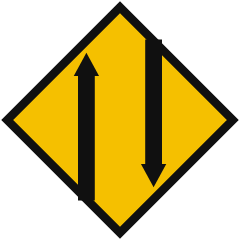
23. What is a driver being warned about here?
Show answer
Answer B: The pavement ahead carries vehicles traveling in the opposite direction
Beyond this point vehicles come the other way on the same pavement, which commonly happens where a one-way section or a separated stretch comes to an end.
-
24. A driver is following your motorcycle much too closely. What should you do?
Show answer
Answer B: Ease off the throttle and open more space ahead so the driver can pass
Slowing gradually and opening a bigger gap in front encourages the tailgater to pass and gives the rider room to stop gently instead of hard.
-
25. You come around a bend and find loose sand spread across your lane. What should you do?
Show answer
Answer D: Ease off the gas, avoid sudden braking or steering, and keep straight
Loose material acts like ball bearings under the tires; smooth inputs preserve what little grip remains, while sudden braking or steering breaks it.
-
26. How much time does Kentucky give a driver to try to reach an attorney before a chemical test is administered?
Show answer
Answer B: At least ten minutes but not more than fifteen
Kentucky affords the driver an opportunity of at least ten and not more than fifteen minutes to contact and speak with an attorney before testing.
-
27. How far ahead should you normally be looking while driving?
Show answer
Answer D: About 12 to 15 seconds of travel ahead
Looking that far ahead, roughly a block in town and much farther on a highway, gives you time to see a problem developing and adjust before it becomes an emergency.
-
28. A regulatory sign posted at the start of a road reads LENGTH LIMIT 30 FEET. What does it control?
Show answer
Answer B: The overall length of vehicle allowed on that road
Some states post a length limit where tight curves or narrow structures lie ahead; it bars vehicles or combinations longer than the figure shown from using that road.
-
29. How many points within a two year period may cause a Kentucky driver's privileges to be suspended?
Show answer
Answer B: 12 points for drivers 18 and older, or 7 points for drivers under 18
The Kentucky Driver Manual states that accumulating 12 points within a two year period, or 7 points for a driver under age eighteen, may lead to suspension after a hearing.
-
30. The engine has warmed up and idles smoothly. What should be done with the choke?
Show answer
Answer C: Turn it off
A warm engine running on a rich mixture wastes fuel, runs poorly and can foul the spark plugs, so the choke is closed once it is no longer needed.