
Kentucky KYTC Motorcycle Practice Test 4
Test 4 of 6. Pick an answer for each question to see if it is right and why; your score appears at the end. You need 24 correct answers to pass, the same ratio as the real Kentucky test.
- Questions30
- Correct to pass24
- Passing score80%
- Minimum ageSee note
-
1. How many points does Kentucky assess for failing to yield to an emergency vehicle?
Show answer
Answer C: 4 points
Kentucky's point schedule assesses four points for failure to yield to an emergency vehicle.
-
2. Once the motorcycle is leaned over and settled in a curve, what should the throttle be doing?
Show answer
Answer C: Held steady or rolled on gently through the curve
A steady or slightly increasing throttle keeps the suspension settled and the weight balanced, while closing it mid-curve unloads the rear tire.
-
3. Traffic is heavy and crawling where a sign warns that your lane ends and two lanes must become one. What is the best practice?
Show answer
Answer C: Use the lane to the end, then take turns merging one by one
In stop-and-go traffic the zipper merge, using both lanes up to the merge point and then alternating, keeps the queue shorter and traffic moving; in free-flowing traffic move over as soon as it is safe.
-
4. A SHOULDER DROP OFF sign warns that
Show answer
Answer B: there is a step down from the pavement to the shoulder
The sign is used where the edge of the pavement stands several inches above the shoulder, which can grab a wheel and pull the vehicle sideways.
-
5. According to the Kentucky Motorcycle Manual, when are turn signals required equipment on a Kentucky motorcycle?
Show answer
Answer B: When they were part of the factory equipment for that model
The Kentucky Motorcycle Manual lists required equipment including mirrors, lights, horn, muffler, brakes and registration, and states that turn signals are required if they were part of the factory equipment for that model.
-
6. A sign on a freeway restricts trucks to the two right-hand lanes. What should a car driver expect in those lanes?
Show answer
Answer A: More heavy vehicles and slower changes of speed
A truck lane restriction concentrates heavy vehicles on the right, and those vehicles accelerate, brake and change lanes far more slowly than cars.
-
7. Where is the oil and grease strip in a lane usually widest and most slippery?
Show answer
Answer D: At toll plazas, bus stops and intersections where vehicles sit and idle
Oil and coolant drip most where vehicles stop, idle and pull away, so the center strip is widest and slickest at toll booths, bus stops and busy intersections.
-
8. On a hot summer day you notice long black strips of crack sealant snaking across the pavement. What should a rider know about them?
Show answer
Answer A: They soften in heat and can be slippery, especially under a leaned tire
Crack sealant gets soft and greasy in the heat, so treat those strips as a low traction surface and avoid braking or hard cornering on them.
-
9. What happens in Kentucky when a driver refuses chemical testing and is later convicted of a second DUI within ten years?
Show answer
Answer B: The refusal is an aggravating circumstance and doubles the mandatory minimum jail term
On a second or greater offense within ten years, refusing a breath or urine test counts as an aggravating circumstance and the mandatory minimum jail sentence is twice as long.
-
10. You are riding directly into a low sun that is glaring off your face shield. What should you do?
Show answer
Answer A: Slow down and assume that drivers ahead of you cannot see you either
Glare cuts what everyone can see, so lower speed buys reaction time, and a driver blinded by the same sun is even less likely to notice a motorcycle.
-
11. The traffic around you is moving well above the limit on a wide highway. What should you do?
Show answer
Answer D: Keep to the limit and stay to the right, letting faster traffic pass
The limit is a legal maximum, and the safe way to differ from the traffic around you is to keep right and let it go by.
-
12. How does becoming chilled affect a rider before any shivering is obvious?
Show answer
Answer D: It slows reactions and clouds judgment while the rider still feels fine
Cooling degrades reaction time and decision making before the rider notices it, so dress for the coldest part of the ride and stop to warm up rather than pressing on.
-
13. What equipment must a Kentucky motorcycle have before anyone may ride as a passenger?
Show answer
Answer A: A permanently attached seat and footrest, both designed to carry passengers safely
The Kentucky Motorcycle Manual states that it is unlawful to operate or ride as a passenger on a motorcycle that does not have a permanently attached seat and footrest specifically designed to carry passengers in a safe manner.
-
14. What does Kentucky require when a driver approaching a stopped emergency vehicle cannot safely change lanes?
Show answer
Answer D: Slow down and continue with caution at a speed safe for conditions
Kentucky's Move Over law requires a lane change where it is safe, and where it is not, the driver must slow down and proceed with caution.
-
15. A driver reaching a stop sign is required to do what?
Show answer
Answer D: Come to a complete stop and then proceed only when it is safe
A stop sign requires a full stop before the stop line, crosswalk or intersection, after which the driver may go on once the way is clear.
-
16. After an hour on a hot highway your tire pressure reads higher than it did in the morning. What should you do?
Show answer
Answer D: Nothing, because pressure rises when tires heat up
Air expands as the tire warms, so a hot reading is normally above the cold setting. Bleeding air off would leave the tire underinflated once it cooled.
-
17. A ball rolls into the street from between parked cars ahead of you. What should you expect and do?
Show answer
Answer A: Expect a child to follow it and be ready to stop
A ball is usually followed by a child who is watching the ball and not the traffic. Slow down and be prepared to stop immediately.
-
18. What is the main danger of grabbing the front brake lever abruptly?
Show answer
Answer D: The front wheel can lock, and a locked wheel cannot steer or balance
The front brake must be squeezed progressively so that weight transfers onto the front tire before full braking force is asked of it.
-
19. How far above the posted speed limit must a driver be for speed to count as an aggravating circumstance in a Kentucky driving under the influence case?
Show answer
Answer C: More than 30 miles per hour above the limit
Kentucky lists operating a vehicle more than 30 miles per hour above the posted limit among the aggravating circumstances that trigger mandatory jail time.
-
20. Who may legally ride a motorcycle in Kentucky without protective headgear?
Show answer
Answer D: An operator over 21 who has held a motorcycle license for one year or more
The Kentucky Motorcycle Manual states that a person may operate without a helmet if he or she is over 21 and has held a motorcycle license for one year or more, while persons under 21 or licensed for less than a year must wear protective headgear.
-
21. What does the RESERVE position on a fuel supply valve do?
Show answer
Answer C: It draws on the small amount of fuel left at the bottom of the tank
A fuel supply valve normally offers OFF, ON, RESERVE and PRIME, and RESERVE taps the last of the fuel so the rider can reach a station.
-
22. What alcohol concentrations put a Kentucky driver in violation of the driving under the influence law?
Show answer
Answer B: 0.08 for drivers 21 and over, and 0.02 for drivers under 21
The Kentucky Driver Manual states that a person violates the law by operating with an alcohol concentration of 0.08 or above, and that a person under twenty-one is in violation at 0.02 or more.
-
23. You have stopped on the shoulder of a highway and want to rejoin the traffic. What is the correct way?
Show answer
Answer D: Signal, build up speed along the shoulder, then merge into a gap
Entering a fast lane at a slow speed is what causes the conflict, so the shoulder is used to gain speed before the merge in the same way as an acceleration lane.
-
24. A signal beside a fire station stays dark until apparatus is about to leave, when it shows yellow and then red. What must a driver do?
Show answer
Answer B: Stop on the red and wait until the signal goes dark again
An emergency vehicle signal is a real traffic signal, so its red indication must be obeyed while the apparatus pulls out into the street.
-
25. You are turning right off a street into a parking lot driveway that crosses a bike lane and a sidewalk. Who has the right of way?
Show answer
Answer D: Pedestrians on the sidewalk and riders in the bike lane
Turning into a driveway means crossing the paths of people who were already traveling straight, so you give way to both the bike lane and the sidewalk.
-
26. You are driving on the through road of a T-intersection and want to turn left into the side road. Oncoming traffic is approaching on the through road. What must you do?
Show answer
Answer C: Yield to the oncoming traffic before you turn
The vehicle waiting in the stem of the T yields to both of you, but you still owe the right of way to oncoming through traffic before turning across it.
-
27. The signal ahead turns yellow while you are approaching it. What does the yellow light mean?
Show answer
Answer C: The red is coming; stop if you can do so safely
A steady yellow warns that the red is next. Stop if you can do so safely; enter the intersection only when stopping would be dangerous.
-
28. What does the choke, or enrichener, do on a motorcycle that has one?
Show answer
Answer B: It gives the engine a richer fuel mixture so a cold engine will start
A cold engine needs more fuel in proportion to air, and the choke supplies that richer mixture until the engine warms up.
-
29. A driver stopped on suspicion of impaired driving refuses to take a chemical test. What happens?
Show answer
Answer D: A license penalty follows for the refusal itself
Under implied consent, holding a license means agreeing to testing, so a refusal brings its own suspension separately from anything the court decides.
-
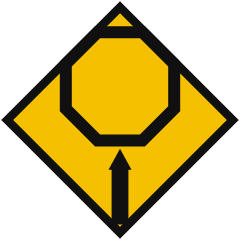
30. What is the driver expected to do after passing this sign?
Show answer
Answer A: Begin slowing so that a complete stop can be made at the intersection ahead
It is used where the control at the intersection stays hidden until late, so braking should begin here rather than at the stop line.