
Kentucky KYTC Motorcycle Practice Test 9
- Questions30
- Correct to pass24
- Passing score80%
- Minimum ageSee note
-
1. The temperature gauge climbs toward the red while you sit in slow moving traffic. What should you do?
Show answer
Answer A: Get out of the traffic as soon as it is safe and let the engine cool
A stationary motorcycle gets almost no airflow through the engine or radiator, so the cure is to stop creeping along in traffic and let it cool.
-
2. Another vehicle is passing you on a two-lane road. What should you do with your speed?
Show answer
Answer A: Hold your speed or ease off slightly to shorten the pass
Speeding up strands the passing driver in the oncoming lane, while a steady speed or a slight lift lets the pass finish quickly and safely.
-
3. Why are sign shapes and colors standardized across the whole country?
Show answer
Answer D: So a driver knows the kind of message before reading it
Uniform shapes and colors let a driver classify a sign as regulatory, warning or guide from a distance, before the legend can be read.
-
4. Why does riding in moderately cold weather call for extra layers of clothing?
Show answer
Answer B: Chill and fatigue set in quickly and reduce the rider's control
Wind at riding speed strips body heat away fast, and a chilled, tired rider reacts more slowly and can slide into hypothermia.
-
5. You arrive at an intersection where the traffic signal is completely dark because of a power failure. How should you proceed?
Show answer
Answer C: Treat the intersection as an all-way stop
When a signal shows no indication at all, drivers on every approach must stop and then take turns, exactly as at an all-way stop.
-
6. You pass into a work zone with a reduced speed limit but you see no workers. What speed applies?
Show answer
Answer D: The posted work zone limit, whether or not workers are present
A posted work zone speed limit is a regulatory limit in force at all times, and narrow lanes and uneven surfaces remain dangerous when nobody is working.
-
7. A yellow diamond reading DIP warns a driver about
Show answer
Answer A: a short, sharp depression in the road surface
A dip is an abrupt low point that can jolt a vehicle or scrape its underside, so speed should be reduced before reaching it.
-
8. What do two solid yellow lines down the middle of a two-way road mean?
Show answer
Answer D: Passing is prohibited for traffic in both directions
A double solid yellow line marks a two-direction no-passing zone, so neither direction may cross it to overtake another vehicle.
-
9. You are stopped in a line of traffic on a steep uphill grade. What should you do about the gap to the vehicle ahead?
Show answer
Answer B: Leave more room than usual, because vehicles can roll back as they pull away
A vehicle ahead can roll back a foot or more as its driver releases the brake, and a motorcycle stopped tight behind it has nowhere to go.
-
10. When should headlights be switched on besides during the hours of darkness?
Show answer
Answer C: Whenever rain, fog, snow or dust makes it harder to see or to be seen
Headlights are as much about being seen as about seeing, so they go on whenever visibility drops.
-
11. What must you do before changing lanes, in addition to signaling and checking your mirrors?
Show answer
Answer D: Glance over your shoulder to check the blind spot the mirrors do not cover
Mirrors leave an area beside and behind the vehicle that they cannot show, so a quick head check is needed before the vehicle moves sideways.
-
12. You face a red light at an intersection that has no stop line and no marked crosswalk. Where must you stop?
Show answer
Answer C: Before entering the intersection
With no line and no crosswalk, the stopping point is the near edge of the intersecting roadway, close enough to see cross traffic but clear of it.
-
13. What must you check about a load before riding away with it?
Show answer
Answer C: That it does not cover the tail light, the brake light or the signals
Luggage that hides the lights leaves drivers behind with no warning that the motorcycle is slowing or turning.
-
14. A driver leaves the vehicle at the curb where this sign is posted and walks away for two minutes. Is that allowed?
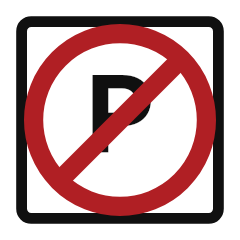
Show answer
Answer B: No, leaving the vehicle unattended there is prohibited whatever the length of the absence
Walking away leaves the vehicle parked, and the prohibition holds regardless of how long the driver is gone or whether the engine is left running.
-
15. What makes a left turn protected rather than permissive?
Show answer
Answer B: Oncoming traffic is held by a red signal while you have a green arrow
A protected turn is one where the conflicting movements are stopped by their own signal, which is what the green arrow indicates.
-
16. You must slow down in a curve but there is no room to straighten the motorcycle. What should you do?
Show answer
Answer A: Brake gently at first and reduce the lean angle as your speed comes down
Braking and turning compete for the same traction, so brake pressure has to stay light while lean angle is high and can grow as the machine comes upright.
-
17. Why is it harder for a rider to judge distance and closing speed after dark?
Show answer
Answer D: Only lights are visible, so closing speeds are hard to read
At night you see lights rather than whole vehicles and the scene around them, which strips away the cues that tell you how far away something is and how fast it is closing.
-
18. You approach an intersection where the signal is flashing yellow. What should you do?
Show answer
Answer D: Slow down and cross the intersection with caution
A flashing yellow signal warns you to slow down and cross with care; it does not require a stop, but it does not give you priority either.
-
19. You are passing a line of slow traffic in the lane beside you and you notice a gap in that line ahead. What should you expect?
Show answer
Answer A: A vehicle may pull out of that gap into your lane
A gap in a slow line is an invitation to any driver waiting to turn out of a side street or to change lanes, and they are looking at the gap rather than at you.
-
20. How much time does Kentucky give a driver to try to reach an attorney before a chemical test is administered?
Show answer
Answer B: At least ten minutes but not more than fifteen
Kentucky affords the driver an opportunity of at least ten and not more than fifteen minutes to contact and speak with an attorney before testing.
-
21. You are turning left from a divided highway through a median opening into a business on the other side. Who has the right of way?
Show answer
Answer C: The traffic on the roadway you are crossing
Turning through a median opening means crossing the opposite roadway, so you yield to all traffic on it before you go.
-
22. A hands free phone conversation is which kind of distraction?
Show answer
Answer C: Cognitive, because your mind leaves the road
Hands free equipment removes the manual and visual parts of a call but not the mental load, and it is the mental load that makes a driver miss hazards.
-
23. A yellow sign reading DEAD END is posted at the entrance to a street. What does it mean?
Show answer
Answer D: The street ends and there is no way through
A dead end street stops at its far end, so a driver who enters must come back out the same way.
-
24. Which clue suggests that a car waiting at a side street is about to pull out in front of you?
Show answer
Answer B: The front wheels are turned and the car is creeping forward
Turned wheels and a slow creep forward are the strongest signs that a driver is about to move, so cover the brakes and be ready to change your lane position.
-
25. An ambulance with lights and siren is coming toward you on an undivided two-lane road. What must you do?
Show answer
Answer A: Pull to the right edge and stop until it passes
On an undivided road, drivers in both directions clear the way, pulling to the right edge and stopping.
-
26. You are wearing a high visibility jacket. How should that change the way you ride?
Show answer
Answer B: You still ride as though drivers have not seen you
Bright gear improves your odds of being noticed but guarantees nothing, so keep the lane position, space cushion and escape routes that protect you anyway.
-
27. What does research say about the effect of a full coverage helmet on a rider's ability to see and hear traffic?
Show answer
Answer B: It leaves the view and the useful hearing a rider needs largely intact
Certified helmets leave far more peripheral vision than a rider needs to check traffic, and riders wearing them still hear the sounds that matter.
-
28. You are turning right off a street into a parking lot driveway that crosses a bike lane and a sidewalk. Who has the right of way?
Show answer
Answer D: Pedestrians on the sidewalk and riders in the bike lane
Turning into a driveway means crossing the paths of people who were already traveling straight, so you give way to both the bike lane and the sidewalk.
-
29. A small plaque mounted under this sign shows a numeral such as 2 or 3. What does that numeral report?

Show answer
Answer A: How many sets of tracks the crossing carries
The plaque states the number of tracks at that location, which is a warning that a second train may be running on another track behind the first.
-
30. A rectangular red sign with the white words WRONG WAY means that
Show answer
Answer C: the driver is already traveling against the legal flow and must not continue
The wrong way sign uses a white legend and border on red and addresses a driver who has entered a ramp or one-way roadway in the wrong direction, who should stop and turn around safely.