
Kentucky KYTC Motorcycle Practice Test 38
- Questions30
- Correct to pass24
- Passing score80%
- Minimum ageSee note
-
1. You are waiting to turn left at a solid green light with no green arrow. Oncoming traffic is approaching. What should you do?
Show answer
Answer A: Yield to the oncoming traffic and turn only when there is a safe gap
A solid green light permits the left turn but does not protect it, so you must yield to oncoming vehicles and to pedestrians before turning.
-
2. How does braking distance change if you double your speed?
Show answer
Answer D: It grows much more than twice as long
Braking distance increases with the square of speed, so doubling speed roughly quadruples the distance needed to stop.
-
3. Is a helmet worth wearing on a short trip to a store a few blocks away?
Show answer
Answer C: Yes, since many crashes happen close to home at ordinary street speeds
A large share of motorcycle crashes occur on short, familiar trips at moderate speeds, and injuries at those speeds are still severe.
-
4. Once the motorcycle is leaned over and settled in a curve, what should the throttle be doing?
Show answer
Answer C: Held steady or rolled on gently through the curve
A steady or slightly increasing throttle keeps the suspension settled and the weight balanced, while closing it mid-curve unloads the rear tire.
-
5. What is the best way to handle fatigue on a long ride?
Show answer
Answer C: Take rest breaks regularly and dress to keep wind and cold out
Wind, vibration and cold tire a rider faster than a driver, and the safe answer is planned breaks and protective clothing rather than pressing on.
-
6. What is the main source of the noise that damages a rider's hearing?
Show answer
Answer A: Wind turbulence around the helmet, which rises sharply with speed
Wind noise around a helmet is loud enough at highway speed to cause permanent hearing loss over time, which is why earplugs are recommended even on quiet machines.
-
7. Cones and drums mark a shifted lane through a work zone. What should you do?
Show answer
Answer A: Follow the path that they mark and stay inside it
Channelizing devices define the temporary travel path, and the space on the other side of them belongs to the workers.
-
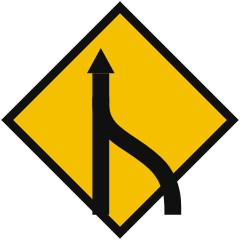
8. What does this sign warn a driver about?
Show answer
Answer A: Traffic from another roadway will enter the same lane ahead
Two traffic streams come together into one lane beyond this point, so drivers on both roadways have to adjust speed and spacing to fit together.
-
9. You enter a corner faster than the turn can be taken. What is the most likely result?
Show answer
Answer A: The vehicle runs wide and may cross into another lane
Excess speed uses up the available grip, so the vehicle follows a wider arc than intended and drifts out of its lane.
-
10. Why is texting considered one of the most dangerous distractions?
Show answer
Answer B: It combines visual, manual and cognitive distraction at the same time
Reading or writing a message takes your eyes off the road, at least one hand off the controls and your attention off driving simultaneously.
-
11. Why do streetcar or light rail rails set into a street deserve extra care from a rider?
Show answer
Answer B: The groove alongside the rail can catch a front tire crossed at a shallow angle
The groove beside an embedded rail is just wide enough to trap a motorcycle tire, so cross rails at as steep an angle as your lane allows.
-
12. How can you check that you are keeping a safe following distance?
Show answer
Answer A: Count at least three seconds between the vehicle ahead passing a fixed object and your reaching it
Pick a fixed roadside object, start counting when the vehicle ahead passes it and make sure at least three seconds elapse before you reach it, adding more time in poor conditions.
-
13. Windblown sand has collected across the pavement at a rural intersection where you must stop. How should you handle the stop?
Show answer
Answer A: Do your braking on clean pavement before the sand, then roll across upright
Sand acts like ball bearings under the tires, so finish your braking on the clean surface ahead of it and cross the loose patch upright with no sudden inputs.
-
14. You are waiting to turn left across two oncoming lanes when a driver in the near lane stops and waves you through. What should you do?
Show answer
Answer D: Turn only after checking the far lane yourself
The waving driver cannot give away the right of way of the traffic in the second lane, which may not be stopping at all.
-
15. How tight should the chin strap of a helmet be?
Show answer
Answer D: Snug under the jaw, tight enough that the helmet cannot be pulled off
A helmet only works if it stays on, so the strap must be fastened snugly under the jaw on every ride, including short ones.
-
16. How much space should you hold behind the rider who is directly ahead of you in your own portion of the lane?
Show answer
Answer D: At least two seconds
Riders sharing the same track keep a following distance of at least two seconds so they have the time and the room to react to a hazard.
-
17. You must leave your vehicle beside a narrow rural road at night. What should you do?
Show answer
Answer B: Get it right off the pavement and switch on the hazard lights
A vehicle left on an unlit rural road is very hard to see, so move it completely clear of the traveled surface and mark it with the hazard lights.
-
18. After a crash, what information should you exchange with the other driver?
Show answer
Answer B: Name, address, driver license, vehicle registration and insurance details
Identification, registration and insurance information are what the other party and the insurers need. Sensitive financial details are never required.
-
19. Which clothing color is most likely to get a rider noticed in daylight?
Show answer
Answer B: Bright orange, yellow or green, which contrast with backgrounds
High visibility colors stand out against road, foliage and vehicles, which helps drivers pick a motorcycle out of a busy background during the day.
-
20. Once you are moving, which way of using a navigation device costs you the least attention?
Show answer
Answer B: Listening to the spoken directions
Voice guidance lets you keep your eyes on the road, while anything that needs the screen takes glances that add up over a trip.
-
21. Traffic has built up behind you while you wait for a gap to turn left. How should that affect your decision?
Show answer
Answer C: It should not change it; wait for a gap that is genuinely safe
Pressure from behind does not make a small gap bigger, and rushing a left turn across traffic is a common cause of serious crashes.
-
22. An oncoming vehicle at night has its high beams on and you are being dazzled. Where should you look?
Show answer
Answer A: Toward the right edge of your lane
Looking toward the right edge line keeps you on course while sparing your eyes the worst of the glare. Slow down and do not retaliate with your own high beams.
-
23. Why is dusk one of the harder times of day to drive?
Show answer
Answer B: The failing light blurs shapes into the background
In fading light there is not enough contrast to pick objects out, yet it is not dark enough for headlights to do the work, so pedestrians and cyclists disappear.
-
24. The red lights on a stopped school bus go out and the bus begins to move away. What should you do?
Show answer
Answer B: Move off slowly and keep watching for children near the road
Children who have just left the bus may still be near the roadway or crossing behind it, so pull away gently and keep looking for them.
-
25. How long can cannabis affect a driver?
Show answer
Answer A: For hours after the strongest effects have passed
Slowed reactions, poor tracking and weak judgment of distance can last for hours, well beyond the point where the user believes the effects are over.
-
26. You are slowing to turn right at an intersection and a bicyclist is riding beside your right side in a bike lane. What should you do?
Show answer
Answer D: Let the bicyclist go through the intersection before you begin the turn
Turning across the path of a bicyclist who is going straight causes the classic right-hook crash. The rider continuing straight has the right-of-way over your turn.
-
27. You are turning right where a paved trail crosses the road just past the corner. What should you look for?
Show answer
Answer B: Cyclists and walkers arriving from either direction on the trail
A shared use path carries two-way traffic on foot and on bicycles, so scan both directions along the trail before crossing it.
-
28. You are about to leave a roundabout when a pedestrian steps into the crosswalk on your exit. What should you do?
Show answer
Answer B: Yield to the pedestrian and wait for the crosswalk to clear
Roundabout crosswalks sit on the entries and exits, and drivers must yield to pedestrians using them.
-
29. The leader gives a hand signal that you can see clearly from your place in the group. What should you do with it?
Show answer
Answer A: Repeat the signal so the riders behind you also receive it
Signals are passed down the line rider by rider, because riders further back cannot see the leader through the machines in between.
-
30. A curb sign reads 2 Hour Parking, 8 AM to 6 PM, Monday to Saturday. When may you stay longer than two hours?
Show answer
Answer A: Outside those hours and on Sundays
A time limit applies only during the days and hours printed on the sign; outside them the ordinary parking rules apply.