
Kentucky KYTC Motorcycle Practice Test 34
- Questions30
- Correct to pass24
- Passing score80%
- Minimum ageSee note
-
1. Which clue tells you that a parked vehicle is about to pull into traffic?
Show answer
Answer D: Exhaust smoke, brake lights, front wheels turned out or a driver in the seat
A running engine, lit brake lights, turned wheels or a person behind the wheel all mean the vehicle may move. Slow down and give it room.
-
2. An overhead sign shows that the right lane is EXIT ONLY. What does that mean if you intend to stay on the highway?
Show answer
Answer B: You have to move out of that lane before the exit
An exit only lane leaves the highway completely, so a driver continuing on the highway has to change lanes before it does.
-
3. What is the correct way to ride across a stretch of slippery pavement?
Show answer
Answer C: Reduce speed before you reach it, avoid sudden moves, and use both brakes gently if you must brake
The speed must come off before the slippery area, and once the tires are on it every input, braking included, has to be smooth and gentle.
-
4. Two drivers each have three drinks, one over three hours and one in half an hour. What is the difference?
Show answer
Answer C: The fast drinker reaches a higher peak level
The liver removes alcohol at a steady rate, so drinking faster than the body can clear it pushes the blood alcohol level much higher.
-
5. Snow has covered the pavement markings on a two-lane road. How should a driver judge lane position?
Show answer
Answer B: By the tracks of other traffic and the roadside features
With the markings hidden, ruts left by earlier traffic, signs, poles and the line of the shoulder are the best clues to where the lane runs.
-
6. Which is an early warning that fatigue is affecting your riding?
Show answer
Answer D: You miss turns and signs and have to think about routine actions
Fatigue shows up first as slower thinking and missed information, so treat lapses in attention as a signal to stop and rest.
-
7. What should be adjusted on the motorcycle before carrying a passenger?
Show answer
Answer C: The suspension and the tire pressure, following the owner's manual
The extra weight compresses the suspension and loads the tires, so both should be set to the values the manufacturer specifies for riding with a passenger.
-
8. When no limit is posted, what is the speed limit on Kentucky interstate highways and parkways?
Show answer
Answer C: 65 miles per hour
The Kentucky Driver Manual lists 65 miles per hour as the speed limit on interstate highways and parkways, although the secretary of transportation may raise specific highways to 70.
-
9. Why is it worth planning your route before a long drive?
Show answer
Answer B: So that you are not reading a map or a screen while the car is moving
A driver who knows the route is not navigating at the wheel, which is one of the commonest sources of distraction.
-
10. You are about to pass a long tractor-trailer on a two-lane road. What should you expect?
Show answer
Answer B: You will need more clear road, since the vehicle is much longer
A tractor-trailer can be 70 feet long, so passing it takes more distance and more time than passing a car at the same speed difference.
-
11. A center lane is bordered by a solid yellow line on the outside and a broken yellow line on the inside, with turn arrows painted inside it. What is that lane for?
Show answer
Answer C: Left turns made by traffic traveling in either direction
That marking pattern identifies a two-way left-turn lane, which drivers approaching from both directions may use to prepare for a left turn.
-
12. Without a depth gauge, how can a rider tell that a tire has worn out?
Show answer
Answer A: The tread has worn down level with the wear bars set into the grooves
Wear bars are molded across the bottom of the tread grooves, and once the tread surface reaches them the tire has no usable depth left.
-
13. The front brake lever feels soft and travels almost to the handgrip. What should the rider do?
Show answer
Answer D: Leave the motorcycle where it is until the brake system has been inspected
A spongy lever usually means air or fluid loss in the system, and a brake in that condition can fail completely under hard use.
-
14. What color scheme does a standard stop sign use?
Show answer
Answer B: White legend and border on a red background
The stop sign carries a white legend and border on a red background, the color set aside for stop, yield and prohibition messages.
-
15. You have stopped on the shoulder of a highway and want to rejoin the traffic. What is the correct way?
Show answer
Answer D: Signal, build up speed along the shoulder, then merge into a gap
Entering a fast lane at a slow speed is what causes the conflict, so the shoulder is used to gain speed before the merge in the same way as an acceleration lane.
-
16. On a narrow two-lane road a line of vehicles has built up behind you. What is the safe and courteous action?
Show answer
Answer D: Pull into a turnout or a safe wide spot and let them go by
A slow vehicle holding up a queue invites risky passing; using a turnout clears the road without anyone having to take a chance.
-
17. The oil pressure warning light comes on while you are riding. What should you do?
Show answer
Answer D: Stop as soon as it is safe and shut the engine off
That light warns that the engine may not be receiving oil, and every extra minute of running risks destroying it.
-
18. A yellow diamond on an exit ramp shows a truck tipping over onto two wheels. Which drivers does it concern most?
Show answer
Answer D: Those in tall vehicles carrying a high load
The truck rollover sign warns that the curve can overturn a vehicle with a high center of gravity, so such drivers must slow well below the normal ramp speed.
-
19. You reach a one-lane bridge and a vehicle is already partway across it coming toward you. What should you do?
Show answer
Answer D: Stop before the bridge and let it come through
A vehicle already on a one-lane bridge has the right of way, and the driver who has not yet entered waits at the approach.
-
20. What should a pre-ride check of the drive chain or belt look for?
Show answer
Answer C: Correct slack, adequate lubrication and no worn or damaged links
A chain that is too tight, too loose, dry or damaged can break or jump the sprocket and lock the rear wheel while the motorcycle is moving.
-
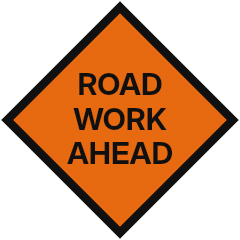
21. Beyond this sign, cones and temporary signs lead traffic along a path that does not agree with the lines painted on the pavement. Which one must the driver follow?
Show answer
Answer C: The temporary arrangement, because it replaces the permanent layout while the work lasts
Temporary traffic control set up for the work takes precedence over the permanent signs and markings, which no longer describe how the road is being used.
-
22. What is a designated driver?
Show answer
Answer A: Someone who agrees to drink nothing at all
A designated driver drinks no alcohol whatsoever, because any amount begins to affect judgment and the whole point is a sober driver.
-
23. Where is passing prohibited even when no line is visible?
Show answer
Answer D: On a curve or near the crest of a hill, at intersections and at railroad crossings
Passing is prohibited wherever your view of oncoming traffic is blocked or where vehicles may cross your path, which includes hills, curves, intersections and rail crossings.
-
24. You are approaching a narrow bridge where the road has one lane in each direction and no shoulder. What should you do about passing?
Show answer
Answer B: Do not pass on or near the bridge
A narrow bridge gives neither vehicle anywhere to go, so passing is prohibited there in the same way as on a hill or in a tunnel.
-
25. You reach the end of the acceleration lane and there is still no gap in the traffic. What should you do?
Show answer
Answer B: Slow down and merge behind the traffic rather than forcing your way in
Merging behind the traffic costs you only a little speed, while forcing into a space that is not there puts you alongside a vehicle with nowhere to go.
-
26. Federal law lets a state open its high-occupancy vehicle lanes to certain vehicles carrying only one person. Which of these is covered by that allowance?
Show answer
Answer B: Motorcycles
Federal law lets states allow motorcycles into high-occupancy vehicle lanes regardless of the number of occupants, because keeping riders in the flow is safer than the alternative.
-
27. When no limit is posted, what is the Kentucky speed limit on state highways that are not interstates or parkways?
Show answer
Answer C: 55 miles per hour
The Kentucky Driver Manual lists 55 miles per hour as the speed limit on all state highways other than interstate highways and parkways.
-
28. You are driving on a rural road with no sidewalk. Where should you expect to meet pedestrians?
Show answer
Answer A: Walking toward you on your side of the road
Where there is no sidewalk, pedestrians are taught to walk facing traffic, so they appear on your side of the road coming toward you.
-
29. At night you are waiting to turn left and can see only the headlights of an approaching vehicle. Why should you allow a bigger margin?
Show answer
Answer D: Because lights alone make speed and distance hard to judge
With no other visual cues, two points of light give you very little information about how fast the vehicle is closing, so leave extra margin.
-
30. What visual acuity must a Kentucky applicant reach at the vision screening before moving on to the written test?
Show answer
Answer C: 20/40 or better
The Kentucky Driver Manual requires a minimum visual acuity of 20/40, corrected or uncorrected, before the applicant may take the written test, with a referral pathway for applicants whose acuity is 20/60 or better after examination.