
Kentucky KYTC Motorcycle Practice Test 23
- Questions30
- Correct to pass24
- Passing score80%
- Minimum ageSee note
-
1. What do the grooves in a tire tread do on a flooded road surface?
Show answer
Answer B: They give the water a way to escape so the tread can touch the road
Tread grooves pump water out from under the tire so rubber can meet pavement. A worn tread moves less water, so hydroplaning starts sooner.
-
2. Blue pavement markings are used together with white markings at
Show answer
Answer D: parking spaces reserved for people with disabilities
Blue supplements the white markings of accessible parking spaces, which is the only assignment blue has on the pavement.
-
3. What kind of gloves are recommended for riding?
Show answer
Answer A: Full fingered gloves of leather or similar durable material
Full fingered leather or equivalent gloves improve grip on the controls and protect the hands, which riders instinctively put out in a fall.
-
4. You are stopped in traffic at a red light when an ambulance comes up behind you with its siren on. What is the correct action?
Show answer
Answer D: Stay put until you can move aside legally and safely
You must not run a red light or make an unsafe move to yield; wait, then pull to the side once the way ahead lets you do it safely.
-
5. A driver who has been drinking has two cups of strong coffee. What has changed?
Show answer
Answer D: The driver is more awake but just as impaired
Coffee can make a drinker feel alert, but nothing except time removes alcohol from the blood, so a wide awake drinker is still an impaired driver.
-
6. The crossbuck, formed by two rectangular arms crossed in an X, is placed
Show answer
Answer D: on each highway approach to a railroad grade crossing
The crossbuck marks the location of a highway-rail grade crossing and is required on each highway approach to that crossing.
-
7. Your phone is in a mount on the dashboard rather than in your hand. What is true?
Show answer
Answer B: It still takes your eyes and mind off the road
A mount solves the hand problem but not the eye or the mind problem, and reading or tapping a mounted screen costs the same seconds of attention.
-
8. Where in the United States may a motorcycle ride between lanes of traffic?
Show answer
Answer C: Only where a state has specifically authorized it
Riding between lanes is prohibited in most states and permitted only where a state law expressly allows it, so a rider must know the rule for the state being ridden in.
-
9. On a long uphill grade a second lane opens on the right and a sign directs slower traffic into it. You are towing a trailer and holding up a line of vehicles. What should you do?
Show answer
Answer A: Move into the right-hand lane and let the faster traffic use the left lane
A climbing lane exists so that slow vehicles can be passed safely, and the slower vehicle is the one that belongs in it.
-
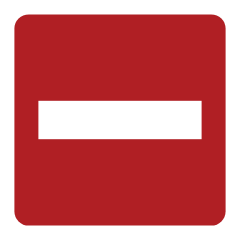
10. At which location is this sign normally installed?
Show answer
Answer D: Facing traffic that could turn into a one-way roadway or ramp against the flow
It is posted where a driver could otherwise enter a ramp or a one-way roadway from the wrong end, so it faces exactly the traffic that has to be kept out.
-
11. Your light turns green, but a vehicle is still in the middle of the intersection. What should you do?
Show answer
Answer D: Wait until the intersection is clear before you move ahead
A green light means go only when the way is clear. Drivers already inside the intersection must be allowed to finish crossing.
-
12. When is the right time to put on rain gear?
Show answer
Answer C: Before the rain reaches you, at a safe place off the roadway
Once you are wet you stay cold for the rest of the ride, so stop somewhere safe and put the rain suit on while you are still dry.
-
13. Why should a rider avoid coasting to a stop with the transmission in neutral?
Show answer
Answer C: Engine braking is lost and so is the ability to accelerate out of trouble
Staying in gear keeps engine braking working and leaves the rider able to power away from a hazard instead of hunting for a gear first.
-
14. Why is the center portion of the lane a useful default on an open road?
Show answer
Answer B: It keeps a space cushion on both sides and discourages lane sharing
From the middle of the lane the rider has room to move either way, and no driver sees an obvious gap alongside to squeeze into.
-
15. You are approaching a highway-rail grade crossing marked only with a crossbuck sign. What does that sign require?
Show answer
Answer A: Yield to any approaching train and cross only when the tracks are clear
The crossbuck is a regulatory yield sign, and a train can never stop or steer around a vehicle, so the driver must always give way.
-
16. You have stopped after a crash. Why should the engines of the vehicles involved be switched off?
Show answer
Answer A: To reduce the risk of a fire starting around any fuel that has spilled
Crashes often break fuel lines, and a running engine is a source of ignition, so switching off lowers the risk of fire.
-
17. The road is icy and visibility is poor, but you are driving at the posted speed limit. Is this acceptable?
Show answer
Answer A: No, because you may never drive faster than is safe for the conditions
Under the basic speed rule a driver must travel at a speed that is reasonable for the actual conditions, so a legal posted speed can still be an unlawful and unsafe speed.
-
18. The front tire suddenly loses air while you are riding. What should you do?
Show answer
Answer D: Hold the bars firmly, ease off the throttle and slow using the rear brake
A deflating front tire makes the steering feel heavy, so the rider keeps a straight line, avoids the affected wheel when braking and eases off the road.
-
19. A school sign combined with an AHEAD plaque, or with a plaque giving a distance in feet, forms an assembly that
Show answer
Answer B: warns of a school crossing located further along the road
The school advance crossing assembly is placed before the crosswalk to give drivers notice, while a different assembly marks the crossing itself.
-
20. You are turning right onto a one-way street. Which lane of that street should you enter?
Show answer
Answer C: The lane closest to the right curb
Even though every lane on a one-way street runs your way, a right turn must end in the lane nearest the right curb; you may change lanes afterwards when it is safe.
-
21. Which of the four blind spots around a tractor-trailer is the largest?
Show answer
Answer A: The one on the right side of the truck
A truck has no-zones on all four sides, and the right-side blind spot is the largest because it runs back along the trailer and reaches across more than one lane.
-
22. What should you expect while driving through a parking lot?
Show answer
Answer D: Pedestrians and vehicles moving from any direction, so drive slowly
Parking lots mix walking people, reversing vehicles and poor sight lines, so low speed and constant scanning are the only reliable protection.
-
23. A high truck ahead of you hides the traffic signal as you approach the intersection. What should you do?
Show answer
Answer A: Drop back so you can see the signal and the truck's brake lights
Extra following distance restores your view of the signal, so you are reacting to the light yourself rather than copying the truck driver.
-
24. Which of these places should never be used to turn your vehicle around?
Show answer
Answer C: The driveway of a fire station or the roadway in front of it
Turning around in or in front of a fire station driveway can block emergency vehicles leaving, and most states prohibit it.
-
25. Your group is turning left across oncoming traffic. What should you do?
Show answer
Answer D: Wait until you personally have a large enough gap to turn
Each rider needs a gap of their own, and turning on the strength of the rider ahead means turning into traffic you have not actually judged.
-
26. In a work zone a flagger signals you to stop, but the sign beside the road says the lane is open. What should you do?
Show answer
Answer C: Obey the flagger
A flagger controls the work zone in real time and the instruction outranks the signs and markings, which cannot reflect what is happening at that moment.
-
27. You feel drowsy, so you open a window and turn the radio up. What does that achieve?
Show answer
Answer B: Very little, because the drowsiness comes back
Cold air and loud music are not sleep, so the alerting effect lasts a minute or two and the driver is soon just as sleepy and closer to a lapse.
-
28. You make eye contact with a driver waiting to pull out of a side street. What should you assume?
Show answer
Answer D: The driver may still not have seen you, so stay ready to slow or stop
Drivers can look directly at you and still not register your vehicle, especially a small one. Eye contact helps, but never rely on it.
-
29. You and an oncoming driver are both turning left at the same intersection. What is the usual rule?
Show answer
Answer D: Both turn in front of each other unless markings show otherwise
The normal practice is to pass driver side to driver side, turning in front of one another, unless pavement markings or signs direct a different path.
-
30. You are stopped at a stop sign waiting to turn onto a highway where traffic moves at 55 mph. How should you choose your gap?
Show answer
Answer A: Wait for a much larger gap than the one you would accept on a city street
Fast traffic covers ground while you are still accelerating, so the gap that feels adequate at 25 mph is dangerously short at highway speed.