
Kentucky KYTC Motorcycle Practice Test 20
- Questions30
- Correct to pass24
- Passing score80%
- Minimum ageSee note
-
1. How do the traffic laws apply to riders traveling in a group?
Show answer
Answer D: Every rider is responsible for obeying the law on their own machine
Riding in company changes nothing legally, and each rider answers individually for speed, signals and every other rule of the road.
-
2. The traffic signal is green, but the crossing lights on the tracks inside the intersection begin to flash. What must you do?
Show answer
Answer C: Stop clear of the tracks and wait, even though the signal is green
Active crossing warning devices outrank the green indication, so you stop short of the rails and wait until the warning stops.
-
3. You receive a phone call that you feel you must answer while driving. What is the safest way to take it?
Show answer
Answer D: Pull off the road, stop in a safe place and then answer
No call is worth a crash. Stopping in a safe location removes the distraction completely, while every other option divides your attention.
-
4. How many points does Kentucky assess for a reckless driving conviction?
Show answer
Answer D: 4 points
Kentucky's point schedule places reckless driving at four points, above careless driving and below improper passing.
-
5. Your vehicle has antilock brakes. What should you never do in an emergency stop?
Show answer
Answer A: Pump the pedal up and down
The system already releases and reapplies the brakes many times a second. Pumping the pedal interrupts it and makes the stop longer.
-
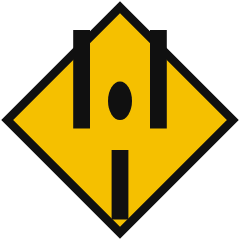
6. Beyond the point this sign refers to, which movement becomes unlawful?
Show answer
Answer D: Driving on the far side of the separation, against the flow
Once the two directions are separated, each roadway carries one-way traffic, so crossing to the other side means driving into oncoming vehicles.
-
7. A car in the lane to your left keeps drifting toward the line between you. Which portion of your lane should you move to?
Show answer
Answer A: The right portion
Moving to the far side of your lane buys distance and time if that driver keeps coming, and it may also make the motorcycle visible to a driver who had not noticed it.
-
8. According to national crash research, how effective are helmets at preventing fatal injuries to motorcycle riders?
Show answer
Answer C: About 37 percent effective
Federal estimates put helmet effectiveness at roughly 37 percent for riders and about 41 percent for passengers in preventing fatal injuries.
-
9. You are riding in the middle of a tight cluster of cars on a multilane road. What is the best way to improve your safety?
Show answer
Answer C: Ride slightly faster or slower to open space and get clear of the cluster
A rider hemmed in on all sides has nowhere to go, so change your speed a little to open an escape path and leave the crowd.
-
10. How may a two-way left-turn lane never be used?
Show answer
Answer B: As a through travel lane or a passing lane
The lane exists only for turning movements, so traveling or passing along it puts you head-on with vehicles turning from the opposite direction.
-
11. Why can a mild afternoon still chill a rider dangerously on the highway?
Show answer
Answer B: Riding speed creates a wind chill well below the air temperature
Air moving over the body at highway speed strips heat far faster than still air, so a comfortable temperature at a standstill can cause serious chilling in an hour of riding.
-
12. Why should riders avoid the center strip of the lane, especially where traffic stops often?
Show answer
Answer A: Because it collects oil and grease dripped from other vehicles
Drippings from other vehicles build up in the center of the lane, and the buildup is heaviest at busy intersections and toll booths where traffic sits waiting.
-
13. What is a good rule for any task you want to do inside the vehicle?
Show answer
Answer D: If it needs more than a moment, do it stopped
A glance of a second or two is manageable, but any task that runs longer belongs to a stopped vehicle, because the road does not pause while you do it.
-
14. Your light turns green, but a vehicle from the cross street is still finishing a turn inside the intersection. What should you do?
Show answer
Answer B: Wait until that vehicle has cleared the intersection
A green indication lets you proceed only after yielding to pedestrians in the crosswalk and to vehicles already lawfully within the intersection.
-
15. You are on a city street with two lanes in your direction, cars parked along the curb and driveways every few yards. Which lane is usually safer?
Show answer
Answer B: The lane farther from the curb, away from opening doors and vehicles pulling out
Most of the hazards on such a street come from the curb side, so the inside lane gives you more space and more time to react.
-
16. A bicyclist is riding around a single-lane roundabout in the middle of the lane as you wait to enter. What is your duty?
Show answer
Answer C: Yield to the bicyclist just as you would to a car
A bicyclist using the roundabout is traffic like any other vehicle and has the same claim to the circulating lane.
-
17. You are waiting to pull out of a driveway when a bicyclist comes along the bike lane in front of you. What must you do?
Show answer
Answer D: Wait until the bicyclist has gone past
A driver leaving a driveway yields to everything already on the road, and a bike lane is part of the roadway.
-
18. The crossing gates begin to lower while your vehicle is still on the railroad tracks. What should you do?
Show answer
Answer B: Keep going forward and push through the gate if it should block your way
Gates are made to break away, and driving forward off the tracks is far safer than staying between them or backing up.
-
19. How much space should the leader of a group keep behind the vehicle ahead of the group?
Show answer
Answer D: At least the normal following distance a rider would keep when riding alone
Riding in a group does not shorten the space a motorcycle needs to stop, so the leader keeps the same cushion any rider would keep alone.
-
20. Why should a rider downshift one gear at a time instead of skipping several at once?
Show answer
Answer D: Skipping gears can lock the rear wheel through sudden engine braking
Dropping several gears at once forces engine speed far above what road speed supports, and the rear tire can be dragged into a skid when the clutch comes out.
-
21. A sign with a green background and a white legend normally provides
Show answer
Answer A: directions, distances and destinations
Green is the background color of the guide sign series, which names routes and destinations and gives the distance to them.
-
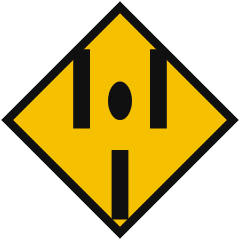
22. What must a driver be ready for beyond this sign?
Show answer
Answer C: Vehicles approaching from the opposite direction in the next lane over
The separation between the two directions runs out, so from that point oncoming vehicles share the same pavement and the driver has to keep right.
-
23. What is wrong with riding in sneakers or sandals?
Show answer
Answer D: They come off, expose the foot and give no protection in a fall
Light footwear tears away or comes off in a crash and offers no abrasion or crush protection for the foot and ankle.
-
24. Why should you make sure your turn signal has stopped flashing after a lane change?
Show answer
Answer A: A signal left flashing tells other drivers that you intend to move again
Other drivers act on your signals, so one that is left on gives them false information about what you are about to do.
-
25. How long is the license suspension for a first Kentucky DUI offense when the driver takes part in the ignition interlock program?
Show answer
Answer D: Four months
Kentucky shortens the first-offense suspension from six months to four when the driver enters the ignition interlock program.
-
26. You have turned onto a ramp at night and your headlights pick out large white arrows painted on the pavement pointing straight back at you. What do they mean?
Show answer
Answer C: You are traveling against the flow and must turn back
Wrong-way arrows are laid so that a driver going the correct way never sees them head on, so an arrow pointing at you means you are on the ramp backwards.
-
27. How many points does Kentucky assess for exceeding the speed limit by 10 miles per hour or less on a limited access highway?
Show answer
Answer B: No points
Kentucky assesses no points for exceeding the limit by 10 miles per hour or less on a limited access highway, though the citation still stands.
-
28. How should following distance change when you ride at night?
Show answer
Answer D: Open it up to three seconds or more
Less light means hazards appear later, so a rider should slow down and stretch the following distance to three seconds or more.
-
29. You are driving through a residential area where parked cars hide the side streets. What is the safest approach?
Show answer
Answer C: Slow down and cover the brake as you pass each opening
Where parked vehicles hide side streets and driveways, lower speed and a covered brake buy the time you lose in sight distance.
-
30. Your passenger wants to carry a bag in one hand during the ride. What should you tell them?
Show answer
Answer B: No, both hands are needed to hold on, so the bag must be secured on the machine
A passenger needs both hands on the operator or the handholds, and anything carried loose can be dropped into the wheel or pull the passenger off balance.