
Kentucky KYTC Motorcycle Practice Test 18
- Questions30
- Correct to pass24
- Passing score80%
- Minimum ageSee note
-
1. Which surfaces usually offer less grip than the pavement around them when wet?
Show answer
Answer B: Painted markings, metal plates and bridge decks
Paint, steel and bridge decks all shed grip when wet or cold, so brake before you reach them rather than on top of them.
-
2. When downshifting as the motorcycle slows, what keeps the rear tire from skidding?
Show answer
Answer A: Easing the clutch lever out smoothly instead of releasing it abruptly
Letting the clutch out gradually lets engine speed and road speed match, so the rear wheel is not forced to slow suddenly.
-
3. Why do many crashes happen on routes the driver knows very well?
Show answer
Answer D: Familiar roads let attention slip into routine
When a route is automatic the mind wanders and hazards get missed, which is why a well known road deserves the same attention as a strange one.
-
4. You come upon a person riding a horse on the roadway ahead of you. What is the correct way to pass?
Show answer
Answer A: Slow down, give plenty of room and do not use the horn
Horses startle easily, and a frightened horse can throw its rider into your path. Pass slowly and wide, and avoid any sudden noise.
-
5. A vehicle ahead of you displays a reflective orange triangle on its rear. What does that emblem tell you?
Show answer
Answer B: The vehicle is built to travel at 25 mph or less
The orange triangle is the slow moving vehicle emblem used on farm and construction equipment designed for 25 mph or less, warning you that you are closing on it much faster than it appears.
-
6. A person with a guide dog is standing at the corner facing the street you are about to cross. What should you do?
Show answer
Answer D: Stop well back and wait quietly for them to decide
Blind pedestrians rely on engine sound to judge traffic, so stop back from the crossing and avoid the horn, which only confuses them.
-
7. A single solid white line separates two lanes running in the same direction. What is it telling drivers?
Show answer
Answer A: Changing lanes there is discouraged
A solid white lane line discourages lane changing, typically where merging or weaving would create a hazard.
-
8. What should a rider understand about the horn on a motorcycle?
Show answer
Answer A: It is often weak and may not be heard, so it never replaces an escape route
A small horn competes with a closed car, a radio and traffic noise, so a rider plans a way out instead of trusting the horn to be heard.
-
9. Besides air pressure, what should a rider look for when inspecting the tires?
Show answer
Answer B: Tread depth, cuts, embedded objects and uneven wear
Worn or damaged tires lose grip and can fail suddenly, and uneven wear also warns of a pressure or alignment problem.
-
10. You are driving on a divided highway and see a solid yellow line along the left side of your lanes. What does it tell you?
Show answer
Answer D: It marks the left edge of the roadway for your direction
On a divided highway or a one-way roadway, the left edge of the traveled way is marked with a solid yellow line.
-
11. A yellow pennant, an isosceles triangle with its long axis horizontal, is reserved for which message?
Show answer
Answer D: No passing zone
The pennant shape is used only for the no passing zone sign, which marks the point where overtaking is no longer allowed.
-
12. Your light turns green and a driver on the cross street enters against a red. What should you do?
Show answer
Answer D: Hold back and let that vehicle go through
Giving up a right of way you are entitled to is the only way to avoid a crash with a driver who has already failed to yield.
-
13. Why does the speed of the right-hand lane of a freeway change so often?
Show answer
Answer B: Vehicles entering and leaving the highway all use that lane
Entrance and exit ramps feed into the right lane, so traffic there is constantly slowing to leave or speeding up to join.
-
14. You are waiting to enter a two-lane roundabout and traffic is circulating in both lanes. What must you do?
Show answer
Answer A: Yield to traffic in both circulating lanes before you enter
Every entry to a roundabout is a yield point, and at a two-lane roundabout that means giving way to vehicles in either circulating lane.
-
15. When did Kentucky enact its Move Over law?
Show answer
Answer D: 2003
Kentucky passed its Move Over law in 2003, requiring drivers to move over for emergency and public safety vehicles displaying flashing lights.
-
16. A broken white line separates your lane from the lane beside it. What does it indicate?
Show answer
Answer C: Both lanes carry traffic in the same direction and lane changes are permitted
White lines separate lanes of traffic moving in the same direction, and a broken white line means changing lanes across it is permitted when it is safe.
-
17. What should a rider do if the front wheel locks during braking?
Show answer
Answer A: Release the front brake immediately, then reapply it firmly
A locked front wheel cannot steer or hold the motorcycle up, so the brake must be released to let the wheel roll again and then reapplied smoothly.
-
18. You expect to be out after dark on a sunny day's ride. What should you plan for eye protection?
Show answer
Answer B: Carry a clear shield to change to when the light drops
A tint that helps in daylight steals light you need at night, and riding with no eye protection is not the answer, so carry a clear shield and change it at dusk.
-
19. A loaded truck is coming up an entrance ramp as you approach in the right lane of the freeway. What is the most helpful action?
Show answer
Answer A: Adjust your speed to open a gap for it
A heavy vehicle accelerates slowly, so opening a gap or moving over costs you seconds and saves the truck driver from being forced to stop on the ramp.
-
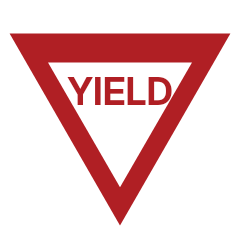
20. Apart from other vehicles, who else must a driver let go first at this sign?
Show answer
Answer A: Pedestrians and cyclists already in or entering the crossing
The duty to give way covers every road user who has the right of way at that point, including people walking or cycling across the driver's path.
-
21. Who is best suited to ride as the sweep at the back of a group?
Show answer
Answer B: An experienced rider who can handle a problem at the back
The sweep has to notice a rider dropping back or stopping and deal with it away from the rest of the group, which takes judgment and experience.
-
22. You are approaching an intersection in a line of traffic. What can you do to be more visible to a driver waiting to pull out?
Show answer
Answer D: Move to a lane position where you are not hidden behind the vehicle ahead
A motorcycle tucked directly behind a larger vehicle is invisible to a waiting driver until the moment it appears, so the rider moves to where the headlight can be seen.
-
23. What should the operator do while a passenger climbs on board?
Show answer
Answer D: Sit on the machine with both feet planted and the front brake held on
The added weight arrives suddenly and off center, so the operator braces the motorcycle with both feet down and the front brake applied to keep it still.
-
24. Why do safety agencies put head protection first among riding gear?
Show answer
Answer A: Because head injuries are the leading cause of death in motorcycle crashes
Head injury is the most common cause of death in motorcycle crashes, which is why a certified helmet is the single most important piece of gear.
-
25. What is the right speed for a normal right turn at a city corner?
Show answer
Answer C: Slow enough to hold your lane and stop for a pedestrian
A city right turn is tight and crosses a crosswalk, so the correct speed is one that keeps you inside your lane and still allows a stop.
-
26. A left-turn bay opens ahead of the intersection with a solid white line beside it. Where should you enter the bay?
Show answer
Answer C: At the opening before the solid line begins
The solid line marks where lane changes are no longer intended, so you move into the turn bay at its opening rather than cutting across the line later.
-
27. A yellow horizontal rectangular sign showing one large arrow pointing left or right, facing traffic on the far side of a sharp bend, tells the driver
Show answer
Answer C: which way the roadway turns at that point
The large arrow sign is mounted on the outside of a sharp change in alignment so that a driver approaching head on immediately sees which way the road goes.
-
28. What must a Kentucky driver do on becoming aware of a vehicle displaying a flashing red or blue light or sounding a siren?
Show answer
Answer C: Drive to the right side of the road clear of any intersection and stop
Kentucky requires drivers to move immediately to the right side of the road or curb, clear of any intersection, and stop until the emergency vehicle has passed.
-
29. How should a rider take curves while carrying a passenger?
Show answer
Answer A: More slowly than when riding alone
The extra weight raises the center of gravity and makes the motorcycle respond more slowly, so curves have to be taken at a lower speed.
-
30. You are turning left from a two-way street onto another two-way street. Where should you begin and end the turn?
Show answer
Answer B: Begin in the lane just right of the center line and finish just right of the center line of the new street
You approach a left turn from the lane closest to the center line and enter the new roadway just to the right of its center line, which keeps you clear of oncoming traffic.