
Kentucky KYTC Motorcycle Practice Test 15
- Questions30
- Correct to pass24
- Passing score80%
- Minimum ageSee note
-
1. You are pulling away from a stop with a passenger for the first time. What should you expect?
Show answer
Answer D: You will need a little more throttle and a slower clutch release
The extra weight makes the motorcycle harder to get rolling, and a rushed clutch release with a passenger aboard is a common way to stall or lurch.
-
2. May you park at the curb immediately next to a railroad crossing?
Show answer
Answer A: No, you must leave the crossing and its approach clear
Parking beside a crossing hides the tracks and the signals from approaching drivers and leaves no room for a vehicle that has to clear the rails.
-
3. Who may legally ride a motorcycle in Kentucky without protective headgear?
Show answer
Answer D: An operator over 21 who has held a motorcycle license for one year or more
The Kentucky Motorcycle Manual states that a person may operate without a helmet if he or she is over 21 and has held a motorcycle license for one year or more, while persons under 21 or licensed for less than a year must wear protective headgear.
-
4. Traffic is backed up just past the exit you want to use at a single-lane roundabout. What should you do?
Show answer
Answer D: Wait at the yield line until you can pass through and exit
You must not enter a roundabout unless you can clear it, because stopping inside blocks every other entry.
-
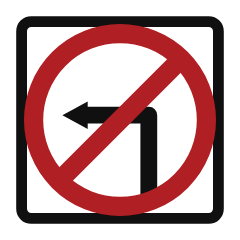
5. No plaque stating days or hours accompanies this sign at the intersection. When does the restriction apply?
Show answer
Answer D: At all times, since nothing limits it to particular periods
A regulatory restriction runs continuously unless a supplemental plaque states the days or hours during which it applies.
-
6. Where should the hooks of an elastic luggage cord be attached?
Show answer
Answer D: To solid points on the frame or the rack that will take the pull
Hooking a cord to bodywork, a signal stalk or a cable can break the part or damage the wiring, and the load is loose the moment the anchor fails.
-
7. Why must a rider turn the head and look before changing lanes?
Show answer
Answer A: Mirrors leave blind spots that only a direct look can cover
Motorcycles have blind spots just as cars do, and a vehicle hidden in one will not appear in the mirrors at all.
-
8. The car ahead of you slows down for no reason that you can see. Should you pull out and pass?
Show answer
Answer B: No, find out why it is slowing before you commit to the other lane
A driver usually slows for something, such as a turn, a hazard or a pedestrian, and that something is often exactly where your pass would take you.
-
9. You have stopped on an uphill grade close behind a large truck at a traffic signal. What is the risk?
Show answer
Answer B: The truck may roll back into you when it starts to move
Heavy vehicles can roll backward a short distance when the driver moves from the brake to the accelerator on a hill. Leave extra room when stopped behind a truck on a grade.
-
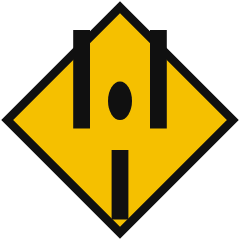
10. What change in the road does this sign announce?
Show answer
Answer B: The two directions of travel are about to be separated, and the driver must keep to the right of the separation
Ahead the roadway splits into separate one-way roadways on either side of a median, so the driver stays to the right of the divider and no longer meets oncoming vehicles.
-
11. Why is passing on a curve prohibited even when the traffic seems light?
Show answer
Answer C: You cannot see far enough around it to know the lane is clear
A pass is only as safe as the distance you can see, and a curve hides the very lane the maneuver uses.
-
12. A lane along the right edge is set off by a solid white line and marked with a bicycle symbol. How should a driver treat it?
Show answer
Answer B: Stay out of it except for the short distance needed to turn or cross where that is allowed
A marked bicycle lane is set aside for bicycle traffic, and motor vehicles may enter it only briefly where turning or crossing is permitted.
-
13. An overhead lane-use control signal shows a steady red X above the lane you are traveling in. What does it require?
Show answer
Answer D: Leave that lane, because it is closed to you
A steady red X means road users are not permitted to use the lane beneath it, so you must move into a lane that is open.
-
14. You are stopping for a red light in the rain and your stopping point is on a wide painted stop line and crosswalk. What should you do?
Show answer
Answer C: Slow earlier and gently, since wet paint offers much less grip than pavement
Painted stop lines and crosswalks turn slick when wet, so start braking early and squeeze gently rather than braking hard on the markings.
-
15. A clutch cable adjusted with no free play at all causes what problem?
Show answer
Answer B: The clutch may slip and never fully engage
Without a small amount of slack the release mechanism keeps a light load on the plates, so they slip instead of transmitting full power.
-
16. What should the clutch be doing during a quick stop?
Show answer
Answer C: Pulled in as the motorcycle slows, so the engine does not stall
Disengaging the clutch as the machine slows keeps the engine running, so the rider can pull away again immediately if that becomes necessary.
-
17. You are traveling beside a tractor-trailer and cannot see the truck driver's face in any of the truck's mirrors. What does that tell you?
Show answer
Answer A: The truck driver probably cannot see your vehicle
Large trucks have deep blind spots on all four sides, so if the driver's face is not visible in a mirror the driver has no view of you. Move ahead or drop back until you are out of that area.
-
18. What should riders expect from highway traffic when a group is merging?
Show answer
Answer C: Drivers will not hold a gap open for the group, so riders take real gaps
Other drivers do not treat a line of motorcycles as one vehicle, so each rider has to find a genuine gap rather than count on being let in.
-
19. On a two-way street, where and how should you park at the curb?
Show answer
Answer C: On the right side, facing the way traffic moves
On a two-way street you must park on the right, headed in the direction of travel; parking facing traffic is prohibited.
-
20. Which of these is announced with the same family of signs as the facility shown here?

Show answer
Answer A: A rest area for travelers
A rest area belongs to the same motorist service series, which points travelers toward facilities such as fuel, food, lodging and medical care.
-
21. You are stopped at an intersection where bushes block your view of cross traffic. What should you do?
Show answer
Answer A: Edge forward slowly until you can see, then proceed when clear
Creeping forward a little at a time lets you gain a view without committing to the crossing. Never enter an intersection you cannot see into.
-
22. An oncoming driver flashes their headlights while you are waiting to turn left. What should you do?
Show answer
Answer D: Judge the situation yourself, since the flash may mean something else
A flash is not a legal signal and may mean many things, so the decision to turn stays yours and must be based on what you can see.
-
23. While you swerve around an obstacle, what should the rest of your body be doing?
Show answer
Answer C: Staying upright with the knees against the tank while the motorcycle leans
A swerve happens through the handlebars, and a body that stays still and anchored to the tank lets the motorcycle move quickly beneath the rider.
-
24. Why must a tank bag be strapped down properly rather than simply laid on the tank?
Show answer
Answer D: Because a bag that slides can reach the controls or your hands
Braking pushes anything loose on the tank forward toward the handlebars, where it can jam the steering or interfere with the levers.
-
25. You have started to pass and you see the no-passing zone beginning ahead. What should you do?
Show answer
Answer D: Ease off, drop back and return to your own lane
A pass must be completed before the no-passing zone starts. If it will not fit, abandon it and slot back in behind.
-
26. A pedestrian near the curb is staring at a phone and not looking at traffic. What should you do?
Show answer
Answer A: Slow down and be ready to stop, because the pedestrian may step out without looking
Distracted pedestrians step into the street without checking. Assume they have not seen you and give yourself time and space to stop.
-
27. How is the yield sign shaped and colored?
Show answer
Answer C: A downward-pointing triangle with a wide red border and a red legend on white
The yield sign is a downward-pointing equilateral triangle with a wide red border and the legend in red on a white background, an outline used for no other message.
-
28. A center lane is marked with a broken yellow line on each side and is controlled by overhead lane signals. How is that lane used?
Show answer
Answer A: It carries traffic one way or the other according to the signals
A reversible lane is marked with broken yellow lines on both sides and its direction of travel is set by the lane control signals above it.
-
29. In most states, when are headlights required apart from times of poor visibility?
Show answer
Answer A: From about half an hour after sunset to half an hour before sunrise
Most states require lights from about half an hour after sunset until about half an hour before sunrise, and some simply say sunset to sunrise; lights are also required whenever visibility is poor.
-
30. You are traveling beside a solid white lane line. What does it tell you?
Show answer
Answer B: Crossing it is discouraged or prohibited, so stay in your lane
A solid white line separates lanes going the same direction where lane changing is discouraged or prohibited, such as where a through lane meets a mandatory turn lane.