
Kentucky KYTC Motorcycle Practice Test 11
- Questions30
- Correct to pass24
- Passing score80%
- Minimum ageSee note
-
1. You have just driven through a deep puddle and your brakes feel weak. What should you do?
Show answer
Answer D: Drive slowly while lightly applying the brakes until they dry and work normally
Wet brakes grip poorly and may pull to one side. Gentle braking at low speed generates heat that dries the pads and discs quickly.
-
2. A steady green downward arrow is displayed above the lane you are in. What does it tell you?
Show answer
Answer A: You may drive in that lane
A green downward arrow means the lane beneath it is open for travel in your direction.
-
3. You are about to accelerate hard to merge with traffic. What should you have arranged with your passenger?
Show answer
Answer D: That you warn them beforehand so they can tighten their grip
A passenger who is not expecting a burst of acceleration is thrown backward, and the sudden shift of weight upsets the machine just when the rider needs it settled.
-
4. You turn left onto a road that has a center two-way left-turn lane. In which lane should you be traveling once the turn is finished?
Show answer
Answer D: The first through lane to the right of the center turn lane
The shared center lane is only for turning movements, so even where a state lets you pause in it to merge you must end up in the first ordinary travel lane beside it.
-
5. Why does full riding gear matter on a short trip around the neighborhood?
Show answer
Answer D: Pavement takes skin off at 25 miles an hour just as it does at 55
Serious injuries happen at ordinary street speeds and close to home, so gear that is worth wearing on a long trip is worth wearing on a short one.
-
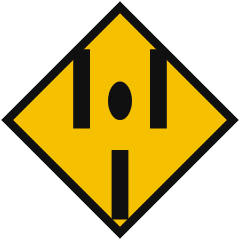
6. What should a driver do first after passing this sign?
Show answer
Answer A: Move into the right-hand lane and stay there
Traffic returns to two-way operation, so the driver keeps to the right of the centerline and stops treating the left side as available.
-
7. Who should set the pace of a group ride?
Show answer
Answer A: The last rider in the group, so that nobody is forced to hurry to keep up
The tail ender sets the pace: every rider watches the mirrors for the rider behind, and if someone falls back the whole group slows a little to stay together.
-
8. Which of these is checked in the Chassis step of T-CLOCS?
Show answer
Answer C: The frame, the suspension, the chain or belt and the fasteners
The chassis step covers the frame and its welds, the front and rear suspension, the final drive and the nuts and bolts holding everything together.
-
9. What does it mean to ride the clutch?
Show answer
Answer C: Holding the lever part way in while riding, which wears the clutch plates
Cruising with the clutch partly disengaged makes the plates slip against each other, which wears them out and removes engine braking.
-
10. You have a steady green ball to turn left, and the oncoming traffic gets a green left arrow. What does that mean for you?
Show answer
Answer C: Oncoming vehicles will turn across your path, so you must wait
A green ball is permissive, so when the oncoming side receives a protected arrow those vehicles have priority and you must yield until they clear.
-
11. What is true about the oily strip down the center of a traffic lane?
Show answer
Answer D: It usually gives enough traction, but heavy buildups where vehicles idle should be avoided
Passing tires keep the central strip largely clear, but the thick deposits that collect at busy intersections and toll booths really are slick.
-
12. What does black ice usually look like from the driver seat?
Show answer
Answer C: A patch of pavement that simply looks wet or slightly glossy
Black ice is clear, so you see the dark road through it and read it as a wet patch. In freezing weather, treat any wet looking patch as ice.
-
13. For an alert driver, about how long is the reaction time once a hazard has been recognized?
Show answer
Answer A: About three quarters of a second
Reaction alone takes roughly three quarters of a second for an alert driver, and perception takes about as long again, so a second and a half of travel is added before the brakes bite.
-
14. What are painted curb markings mainly used for?
Show answer
Answer D: Conveying parking and stopping regulations
Colored curbs tell drivers where waiting or parking is restricted, and because the exact color meanings are set locally a driver should also read the posted signs.
-
15. When does Kentucky's texting ban apply?
Show answer
Answer C: While the vehicle is in motion
Kentucky's ban on texting is written around the vehicle being in motion, not around the road being used or the time of day.
-
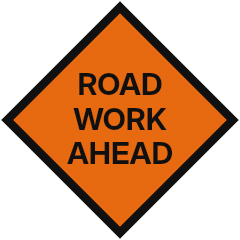
16. How should speed and following distance be adjusted beyond this sign?
Show answer
Answer D: Cut speed and leave a longer gap, because traffic can stop without warning
Traffic in these areas stops and starts unexpectedly and there is little room to steer around a problem, so extra space is what prevents a rear-end collision.
-
17. You are approaching an uncontrolled intersection on a residential street where parked cars hide the cross street. What is the correct approach?
Show answer
Answer B: Slow enough to stop and creep out until you can see
Without a sign or signal you still have to be able to yield, and you cannot yield to traffic you have not seen.
-
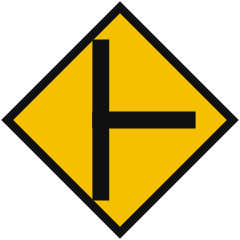
18. Approaching the point this sign refers to, which hazard is most likely?
Show answer
Answer A: A vehicle pulling out from the entering road into the driver's path
The main risk is a driver on the entering road who misjudges the gap and pulls out, so covering the brake and being ready to slow is the sensible response.
-
19. You are moving at walking pace through a crowded parking area. Which combination gives the steadiest control?
Show answer
Answer B: Steady throttle, the clutch held in the friction zone and light rear brake
Slipping the clutch in the friction zone against a steady throttle and a light drag of rear brake keeps power smooth and the machine stable below walking speed.
-
20. At a stop sign with a painted stop line and a crosswalk, where must you stop?
Show answer
Answer D: At the stop line, before it and before the crosswalk
You stop at the stop line first, and only if there is no stop line do you stop before the crosswalk, and only if there is neither do you stop before entering the intersection.
-
21. On a two-lane road with a broken yellow center line, may you cross it to turn into a driveway on the left?
Show answer
Answer C: Yes, when it is safe and the oncoming lane is clear
A broken center line may be crossed for a pass or for a left turn into a road or a driveway, once the oncoming lane is clear.
-
22. What is the correct way to apply the front brake when you need maximum braking?
Show answer
Answer C: Squeeze it progressively harder as weight settles onto the front tire
Progressive pressure lets load build on the front tire before the braking force does, so the tire has the grip needed to handle it.
-
23. You reach a red light with a sign reading NO TURN ON RED. What may you do?
Show answer
Answer D: Wait for the green; no turn is allowed while the light is red
That sign removes the usual permission to turn on red at the intersection, so you must wait for a green indication.
-
24. You see a shield for a three-digit Interstate whose first digit is even. What does that tell you about the route?
Show answer
Answer C: It loops around a city and rejoins its parent route
A three-digit Interstate beginning with an even digit is a loop or beltway that connects back to the main route at both ends, while an odd first digit marks a spur.
-
25. You have just ridden over a large object lying in the road. What should you do next?
Show answer
Answer A: Pull over when it is safe and check the tires and rims for damage
An impact can cut a tire, dent a rim or bend a fork without giving any immediate change in how the machine feels, so it deserves a look.
-
26. Yellow signs each showing one large black arrowhead, installed in a row along the outside of a curve, are
Show answer
Answer D: chevron alignment signs marking the change of direction of the curve
Chevron alignment signs are placed on the outside of a curve so that several are in view at once, letting the driver judge how sharply the road turns.
-
27. After the leader of a staggered group completes a pass, what should the leader do?
Show answer
Answer A: Move to the left position and hold passing speed to open room for the next rider
Returning to the left position and keeping speed opens the gap the next rider needs to finish the pass and settle back into formation.
-
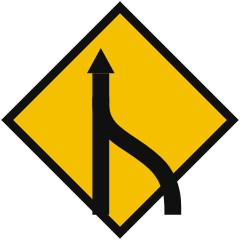
28. Why does the situation ahead of this sign deserve extra care from a motorcyclist?
Show answer
Answer C: Because a narrow machine is easy to overlook in a mirror or a blind spot
A motorcycle fills very little of a mirror and disappears easily into a blind spot, so the rider should adjust speed and lane position to stay visible where the streams come together.
-
29. A driver extends the left arm out the window and bends it upward at the elbow. What does this signal mean?
Show answer
Answer B: A right turn
The left arm bent upward at the elbow is the standard hand signal for a right turn.
-
30. You have a green arrow to turn left. What still applies?
Show answer
Answer D: You must yield to any pedestrian or vehicle still inside the intersection
A green arrow protects your turn from conflicting traffic, but you must still let anyone already in the intersection get clear before you move.