
Kentucky KYTC Permit Practice Test 28
- Questions40
- Correct to pass32
- Passing score80%
- Minimum age15 years
-
1. You are backing out of a space in a parking lot. Who has the right of way?
Show answer
Answer D: Traffic already moving in the lane, and pedestrians walking behind you
A driver backing out must yield to vehicles and pedestrians already using the lane, because backing is the movement with the poorest view.
-
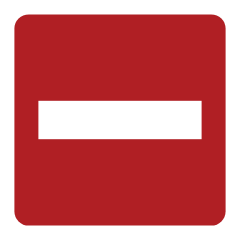
2. At which location is this sign normally installed?
Show answer
Answer D: Facing traffic that could turn into a one-way roadway or ramp against the flow
It is posted where a driver could otherwise enter a ramp or a one-way roadway from the wrong end, so it faces exactly the traffic that has to be kept out.
-
3. A trailer that sways badly at speed is often loaded the wrong way. What is the usual fault?
Show answer
Answer A: Too much of the load sits behind the trailer axle
Weight behind the axle lightens the hitch and lets the trailer wag the vehicle. Most of the load should sit ahead of the axle to keep weight on the hitch.
-
4. If you must abandon a vehicle stuck on the tracks with a train coming, why do you move toward the train and away at an angle?
Show answer
Answer D: Because debris from the impact is thrown forward, away from the train
A train pushes wreckage down the track ahead of it, so walking toward the train and off to the side keeps you out of the debris path.
-
5. Is it acceptable to leave your vehicle across the entrance of an alley for a short time?
Show answer
Answer A: No, the entrance must stay clear at all times
Blocking an alley entrance traps the vehicles inside and can keep emergency services out, so it is prohibited however brief the stop.
-
6. You are about to descend a long steep grade. How should you control your speed?
Show answer
Answer D: Select a lower gear before starting down and use the brakes in firm, brief applications
Engine braking in a lower gear carries most of the load down the grade, while continuous brake pressure overheats the brakes and reduces their effectiveness.
-
7. What do the grooves in a tire tread do on a flooded road surface?
Show answer
Answer B: They give the water a way to escape so the tread can touch the road
Tread grooves pump water out from under the tire so rubber can meet pavement. A worn tread moves less water, so hydroplaning starts sooner.
-
8. In a work zone a flagger is directing traffic in a way that conflicts with the posted signs. Whom do you follow?
Show answer
Answer B: The flagger's directions
A flagger controls traffic through a work area that changes from day to day, and those instructions take precedence over the fixed signs and markings in that zone.
-
9. Why is following distance measured in seconds rather than in car lengths?
Show answer
Answer A: Because a time gap automatically grows with speed, while a fixed number of car lengths does not
A gap counted in seconds keeps the same margin of reaction time at any speed, whereas a fixed number of car lengths becomes far too small as speed rises.
-
10. You have to leave a trailer parked on a slope. What extra step protects it?
Show answer
Answer D: Chock the trailer wheels as well as setting the brake
Chocks physically block the wheels, which is the only thing that still holds if a brake or a coupling lets go.
-
11. Under Kentucky law, which children must ride in a child booster seat?
Show answer
Answer A: Children under 8 years old who are between 40 and 57 inches in height
The Kentucky Driver Manual states that a child 40 inches or less in height must use a child restraint system, and a child under eight years old who is between 40 and 57 inches must be secured in a booster seat.
-
12. Which of these does NOT affect how fast alcohol reaches the bloodstream?
Show answer
Answer A: How confident the drinker feels
Food, the strength of the drinks and the speed of drinking all change how fast alcohol is absorbed, but a drinker's confidence changes nothing at all.
-
13. A sign with a yellow background and a black legend generally conveys
Show answer
Answer B: a general warning
Yellow is the background color used for general warning signs, so a yellow sign tells the driver to expect something ahead rather than to obey a rule.
-
14. What must a Kentucky driver complete before moving from an intermediate license to a full unrestricted license?
Show answer
Answer A: Hold the intermediate license 180 days, complete driver education, and reach age 17
The Kentucky Driver Manual states that drivers are eligible for a full unrestricted license after holding the intermediate license for 180 days, completing the driver education requirements, and reaching age 17.
-
15. Every signal head at an intersection is flashing red in all directions. How should you treat the intersection?
Show answer
Answer C: As an all-way stop, stopping and then going in turn
Red flashing in every direction means each approach must stop, so the intersection works exactly like an all-way stop.
-
16. Traffic is backed up beyond a railroad crossing. When may you start across the tracks?
Show answer
Answer B: Only when there is room for your whole vehicle on the far side
Never enter a crossing you cannot clear; a vehicle stopped on the tracks in a queue has nowhere to go if the signals start.
-
17. A vehicle in the lane beside you has stopped at a crosswalk. What should you do?
Show answer
Answer C: Stop as well, because that driver may be yielding to a pedestrian you cannot see
The stopped vehicle hides the crosswalk from you, and passing it is a leading cause of collisions with pedestrians who are already crossing.
-
18. Smoke and flames appear from the engine compartment after you stop. What should you do?
Show answer
Answer A: Get everyone well away from the vehicle first, and then call the fire service
A vehicle fire can spread within seconds, so people come out first and firefighting is left to the fire service.
-
19. A marked accessible space is signed as van accessible. What is different about it?
Show answer
Answer B: It has a wider aisle for a ramp or a lift to come out
The extra width beside the space is there so a side ramp or lift can deploy and a wheelchair can get clear of the vehicle.
-
20. Compared with dry pavement, how much room does a vehicle need to stop on packed snow?
Show answer
Answer D: Several times as much
Grip on packed snow is a fraction of that on dry pavement, so stopping distance grows several times over. Antilock brakes help you steer, not stop shorter.
-
21. What injury does a correctly set head restraint help prevent?
Show answer
Answer A: A neck injury of the kind caused when your vehicle is struck from behind
In a rear impact the body is pushed forward and the head restraint stops the head from whipping backward.
-
22. A driver ahead brakes for no reason you can see, again and again. What should you do?
Show answer
Answer B: Increase your following distance and be ready for yet another stop
Unexplained braking tells you the driver is unsure or distracted, so the safe answer is more room, not less.
-
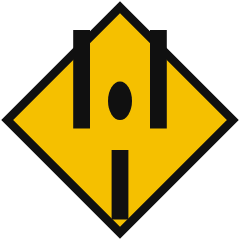
23. What change in the road does this sign announce?
Show answer
Answer B: The two directions of travel are about to be separated, and the driver must keep to the right of the separation
Ahead the roadway splits into separate one-way roadways on either side of a median, so the driver stays to the right of the divider and no longer meets oncoming vehicles.
-
24. On a multi-lane street, a yield line is painted well back from an unsignalized crosswalk rather than right at it. Why?
Show answer
Answer D: So drivers in the other lanes can see the pedestrian
Setting the yield line back keeps a stopped vehicle from hiding a crossing pedestrian from drivers in the next lane, which is a common cause of these crashes.
-
25. There is a driveway and a side street between you and the corner where you will turn right. When should you signal?
Show answer
Answer C: After passing the openings, so nobody pulls out in front of you
A signal switched on before an opening tells drivers waiting there that you are turning in, and they may pull out into your path.
-
26. Two left-turn lanes are available and you must turn right again a short distance after the turn. Which of the two should you use?
Show answer
Answer D: The right one, so you finish nearer the right side of the new street
Each turn lane feeds the matching lane of the new street, so choosing the right-hand of the two left-turn lanes leaves you closer to the side you will need.
-
27. What most often starts a rear wheel skid?
Show answer
Answer A: Too much speed, braking or acceleration for the grip available
A skid begins when what you ask of the tires exceeds what the surface can give, which is usually a matter of speed and of how abruptly you use the controls.
-
28. A school crossing guard steps into the roadway and holds up a stop paddle. What must you do?
Show answer
Answer D: Stop and stay stopped until the guard and the children have left the road
A crossing guard directs traffic with legal authority; you must remain stopped until both the guard and the children are clear of the roadway.
-
29. You are approaching an uncontrolled intersection on a residential street where parked cars hide the cross street. What is the correct approach?
Show answer
Answer B: Slow enough to stop and creep out until you can see
Without a sign or signal you still have to be able to yield, and you cannot yield to traffic you have not seen.
-
30. Beside an accessible parking space there is an area painted with diagonal stripes. What is it for?
Show answer
Answer C: It is an access aisle for wheelchairs and lifts, and no vehicle may park or stop in it
The striped access aisle gives the room a ramp or lift needs to deploy, so blocking it makes the adjacent accessible space unusable.
-
31. How many points does Kentucky assess for exceeding the speed limit by 10 miles per hour or less on a limited access highway?
Show answer
Answer B: No points
Kentucky assesses no points for exceeding the limit by 10 miles per hour or less on a limited access highway, though the citation still stands.
-
32. Which surfaces usually offer less grip than the pavement around them when wet?
Show answer
Answer B: Painted markings, metal plates and bridge decks
Paint, steel and bridge decks all shed grip when wet or cold, so brake before you reach them rather than on top of them.
-
33. You approach an intersection where the signal is flashing yellow. What should you do?
Show answer
Answer D: Slow down and cross the intersection with caution
A flashing yellow signal warns you to slow down and cross with care; it does not require a stop, but it does not give you priority either.
-
34. Why does even a small reduction in speed matter so much where people are walking?
Show answer
Answer D: Because a pedestrian struck at a lower speed is far more likely to survive
The chance that a pedestrian survives falls steeply as impact speed rises, so a few miles per hour can decide the outcome.
-
35. Why should you not rest your foot on the brake pedal as you drive?
Show answer
Answer D: The brake lights stay on and the drivers behind cannot read you
Resting on the pedal keeps the brake lights lit and wears the brakes, so following drivers stop believing your brake lights.
-
36. You are behind a slow vehicle on a two-lane road and a marked passing lane begins a mile ahead. What is the sensible choice?
Show answer
Answer D: Wait for the passing lane rather than using the opposing lane
A passing lane lets you overtake without ever entering the lane used by oncoming traffic, which is far safer than a pass a minute earlier.
-
37. You are approaching the entry of a modern roundabout. Who must you yield to?
Show answer
Answer C: Traffic already circulating in the roundabout, which approaches from your left
Traffic in a United States roundabout circulates counterclockwise, so drivers entering must look left and yield to vehicles already in the circulating roadway.
-
38. A sign at the approach to a bridge reads WEIGHT LIMIT 10 TONS. What does the figure set?
Show answer
Answer B: The heaviest vehicle the bridge may legally carry
A weight limit sign is a regulation based on what the structure can bear, and it applies to the loaded weight of the whole vehicle.
-
39. What visual acuity must a Kentucky applicant reach at the vision screening before moving on to the written test?
Show answer
Answer C: 20/40 or better
The Kentucky Driver Manual requires a minimum visual acuity of 20/40, corrected or uncorrected, before the applicant may take the written test, with a referral pathway for applicants whose acuity is 20/60 or better after examination.
-
40. How much moving water is generally enough to float and carry away most passenger vehicles?
Show answer
Answer D: About one foot
About a foot of moving water will float most cars, and even less will stall an engine. That is why the rule is to turn around instead of judging the depth.