
Kentucky KYTC Permit Practice Test 17
- Questions40
- Correct to pass32
- Passing score80%
- Minimum age15 years
-
1. Alcohol is classified as which kind of drug?
Show answer
Answer B: A depressant that slows the central nervous system
As a depressant, alcohol slows the brain and nervous system, which lengthens reaction time and dulls the coordination that driving depends on.
-
2. The car ahead drifts across the lane line and back again several times. What should you do?
Show answer
Answer C: Assume that the driver is distracted or impaired, and keep well back
Drifting is a classic sign of a distracted, drowsy or impaired driver, and distance is your protection from all three.
-
3. You are waiting in a left-turn lane at a green light when a fire engine with lights and siren comes toward you in the oncoming lanes. What should you do?
Show answer
Answer D: Hold your position and let the fire engine pass
Turning across the path of an approaching emergency vehicle is exactly what you must not do; stay put until it has gone by.
-
4. The blue signs mounted before a freeway interchange that carry the logos of individual businesses are
Show answer
Answer C: specific service signs, which show the brands available at that exit
Specific service signs, often called logo signs, list eligible businesses for categories such as gas, food, lodging, camping, attractions and 24-hour pharmacies at the upcoming interchange.
-
5. The trapezoid sign shape is associated with
Show answer
Answer C: recreational and cultural interest area signing
The trapezoid is used for recreational and cultural interest area guide signs and for national forest route markers.
-
6. What is threshold braking?
Show answer
Answer C: Braking hard but staying just short of locking the wheels
A rolling tire grips better than a sliding one, so the shortest stop comes from pressure held just below the point where the wheels lock.
-
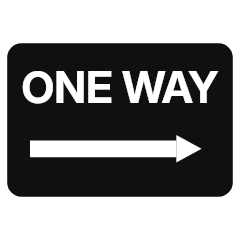
7. A driver disregards this sign and turns so as to travel against the direction it establishes. What is the immediate danger?
Show answer
Answer D: The driver will face traffic head on, because every lane comes the other way
Turning against the established direction puts the vehicle nose to nose with all the traffic on that street, which is why the mistake has to be corrected at once.
-
8. Why is an underinflated tire especially risky on a long drive in hot weather?
Show answer
Answer C: It flexes more, builds up heat and can fail at speed
A soft tire flexes on every rotation, and that flexing makes heat that the hot road and high speed add to until the tire can come apart.
-
9. You are hosting a party and a guest who has been drinking wants to drive home. What should you do?
Show answer
Answer D: Stop serving and arrange a ride or a bed
Only time removes alcohol, so a host who wants to prevent a crash has to remove the driving, not try to speed up sobering that cannot be sped up.
-
10. A yellow diamond showing a bicycle is posted on a rural road. What should a driver expect?
Show answer
Answer A: Bicyclists crossing or riding along the roadway there
The bicycle warning sign is used where a bikeway crosses the road or where riders are likely to be in the traffic lanes, so drivers should look carefully and pass wide.
-
11. A ball rolls into the street from between parked cars ahead of you. What should you expect and do?
Show answer
Answer A: Expect a child to follow it and be ready to stop
A ball is usually followed by a child who is watching the ball and not the traffic. Slow down and be prepared to stop immediately.
-
12. A steady downward green arrow is displayed over a lane. What does it indicate?
Show answer
Answer C: The lane is open to traffic in your direction
A steady downward green arrow means the lane it points to is open to traffic traveling in your direction.
-
13. A regulatory sign reads TURN ON HEADLIGHTS NEXT 15 MILES. What does it require?
Show answer
Answer C: Low beam headlights on for that stretch, day or night
Such a section is signed where a road is hard to see along, and the requirement is to run headlights, not just daytime running lamps, through the whole stretch even in bright daylight.
-
14. A deer suddenly steps onto the road ahead of you at night. What is the safest response?
Show answer
Answer C: Brake firmly and stay in your lane rather than swerving
Swerving at speed often leads to a rollover or a head-on crash that is far worse than hitting the animal. Brake hard, hold your lane and expect more deer to follow.
-
15. On an undivided two-lane road you meet a school bus coming toward you with its red lights flashing and its stop arm out. What must you do?
Show answer
Answer C: Stop and wait until the red lights stop flashing
On an undivided road drivers in both directions must stop for a school bus loading or unloading, because children may cross in front of it.
-
16. You are approaching the entry of a roundabout and a pedestrian is crossing the marked crosswalk on your approach lane. What must you do?
Show answer
Answer D: Stop before the crosswalk and let the pedestrian cross
Roundabout crosswalks sit a short distance back from the yield line, and drivers must yield there before they ever reach the circulating lanes.
-
17. At an intersection where turning right on red is permitted and no sign prohibits it, what must you do before turning?
Show answer
Answer A: Come to a complete stop and yield to pedestrians and cross traffic
A right turn on red is allowed only after a full stop, and the turning driver must yield to pedestrians in the crosswalk and to traffic already using the intersection.
-
18. Which steering method gives the most control when you must turn the wheel a long way at low speed?
Show answer
Answer C: Hand over hand, feeding the wheel from one hand to the other
Hand over hand keeps both hands on the wheel through a large turn, so you never lose the ability to correct quickly.
-
19. You feel drowsy, so you open a window and turn the radio up. What does that achieve?
Show answer
Answer B: Very little, because the drowsiness comes back
Cold air and loud music are not sleep, so the alerting effect lasts a minute or two and the driver is soon just as sleepy and closer to a lapse.
-
20. A bicyclist ahead of you extends the left arm out with the forearm bent upward. What does that signal mean?
Show answer
Answer A: The bicyclist intends to turn right
Bicyclists use the same hand signals as drivers: left arm straight out means left, left arm bent up means right, and left arm bent down means stop or slow.
-
21. You park facing downhill on a one-way street where the curb is on your left. Which way do the front wheels go?
Show answer
Answer A: Left, toward the curb on that side
Standard practice follows the curb rather than the side of the road: facing downhill the wheels point into the curb so a rolling vehicle is stopped by it. States differ on whether this is legally required.
-
22. You have parked a manual transmission car facing downhill. Which gear should you leave it in?
Show answer
Answer D: Reverse, along with the parking brake set firmly
Facing downhill the car would roll forward, so reverse gear opposes that movement while the parking brake and turned wheels back it up.
-
23. You are about to leave a roundabout when a pedestrian steps into the crosswalk on your exit. What should you do?
Show answer
Answer B: Yield to the pedestrian and wait for the crosswalk to clear
Roundabout crosswalks sit on the entries and exits, and drivers must yield to pedestrians using them.
-
24. The light turns yellow when your front wheels are already past the stop line inside the intersection. What should you do?
Show answer
Answer B: Keep going and clear the intersection without speeding up
Once you are legally in the intersection the safest and correct action is to continue through and clear it, without accelerating.
-
25. An emergency vehicle is stopped on the shoulder ahead with its lights flashing. What does the move over principle require?
Show answer
Answer D: Change lanes away from it, or slow down if you cannot
Move over laws ask you to give responders an empty lane, and where traffic or a two-lane road makes that impossible, you slow down instead.
-
26. A deer has just crossed in front of you on a stretch signed for animal crossings. What is the best assumption?
Show answer
Answer B: More animals are likely to follow the first one
Deer travel in groups, so one animal crossing usually means others are about to follow, and a driver should slow and keep scanning both shoulders.
-
27. You have brought the vehicle under control after a blowout. What should you do next?
Show answer
Answer A: Signal and coast well off the road before stopping
Let the speed fall, signal, and leave the roadway as far from traffic as you can before you stop. Driving on a failed tire ruins the wheel and risks control.
-
28. An ambulance with lights and siren is coming toward you on an undivided two-lane road. What must you do?
Show answer
Answer A: Pull to the right edge and stop until it passes
On an undivided road, drivers in both directions clear the way, pulling to the right edge and stopping.
-
29. You are stopped inside an intersection waiting for a gap to turn left. How should your front wheels be positioned?
Show answer
Answer C: Pointing straight ahead until you actually begin the turn
If your wheels are already turned left and another vehicle strikes you from behind, you would be pushed into oncoming traffic.
-
30. You arrive at an intersection with no signs, no signals and no markings at the same time as a vehicle on the road to your right. What must you do?
Show answer
Answer B: Yield to the vehicle on your right
At an uncontrolled intersection you must yield to a vehicle already in the intersection or approaching from your right.
-
31. Which statement best describes what the basic speed law requires of you?
Show answer
Answer C: That you never drive faster than is reasonable and safe for the conditions
Nearly every state has a basic speed law that makes the conditions the real limit: weather, traffic, light and road surface can all require a speed well below the posted number.
-
32. Besides the traffic behind you, what else must you check before moving into the next lane?
Show answer
Answer D: That there is room ahead in the new lane for your normal following distance
Moving into a gap that is too short leaves you tailgating the vehicle ahead with a vehicle close behind you.
-
33. You are approaching a narrow bridge where the road has one lane in each direction and no shoulder. What should you do about passing?
Show answer
Answer B: Do not pass on or near the bridge
A narrow bridge gives neither vehicle anywhere to go, so passing is prohibited there in the same way as on a hill or in a tunnel.
-
34. You are making a legal U-turn at an intersection. Who has the right of way?
Show answer
Answer C: Everyone else, until your turn is complete
A U-turn crosses several paths at once, so you yield to oncoming vehicles, to crossing traffic and to pedestrians before starting it.
-
35. You enter a work zone at night where one lane is closed and a flagger is on duty. What is the safest approach?
Show answer
Answer A: Slow early, merge before the closure and be ready to stop
Merging early at a reduced speed keeps the queue orderly and leaves you room to stop for equipment, workers or traffic that has halted ahead.
-
36. How closely may a Kentucky driver follow an emergency vehicle that is responding to a call?
Show answer
Answer D: No closer than 500 feet
Kentucky makes it unlawful to follow any emergency vehicle closer than 500 feet.
-
37. You are turning left at an intersection and an oncoming bicyclist is approaching in the bike lane. What must you do?
Show answer
Answer B: Yield and complete the turn only after the bicyclist has passed
A bicycle in the roadway has the same right of way as a vehicle, so a left-turning driver must yield to an oncoming rider just as to an oncoming car.
-
38. A large truck ahead of you in a roundabout is using part of both lanes as it goes around. What is the correct response?
Show answer
Answer B: Stay back and give it room until it leaves the roundabout
Long vehicles need extra width to get around the central island, so drivers behind must hold back rather than share the space beside them.
-
39. What happens in Kentucky when a driver refuses chemical testing and is later convicted of a second DUI within ten years?
Show answer
Answer B: The refusal is an aggravating circumstance and doubles the mandatory minimum jail term
On a second or greater offense within ten years, refusing a breath or urine test counts as an aggravating circumstance and the mandatory minimum jail sentence is twice as long.
-
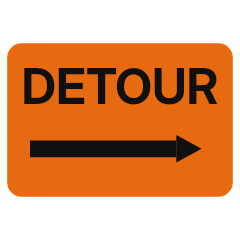
40. Which of these is true of the roadway a driver is being sent onto here?
Show answer
Answer D: Its own signs, signals and speed limits govern for the whole way around
The alternate route is an ordinary public road, so every control posted on it governs as usual; being sent that way grants no extra priority and no relief from the limits in force there.